
Actualizado noviembre 2025 [English version below]
En 1993 un grupo de espeleólogos halló un esqueleto humano parcial al fondo de la Gruta de Lamalunga, cerca de la pequeña localidad de Altamura, en el sur de Italia. Se encuentra embebido en una gran columna de calcita sobre la que han crecido coraloides (pequeños espelotemas con forma de coral). Su localización le da un aspecto único y espectacular, pero hace complejísima su extracción. En principio se asoció a Homo heidelbergensis, pero en 2015 se presentó el análisis de su escápula derecha, incluyendo el ADN mitocondrial que se pudo recuperar de ella, y que determinó la pertenencia a Homo neanderthalensis.
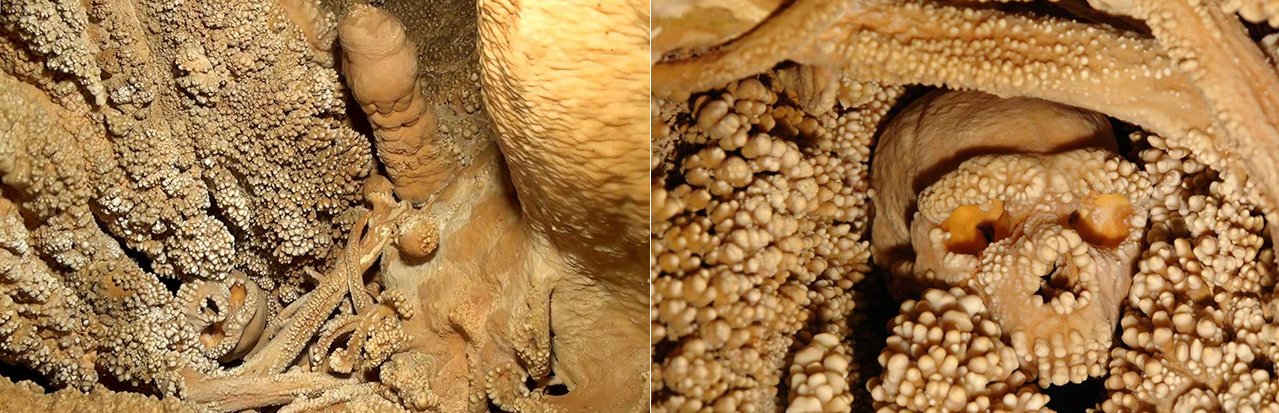
Neandertal de Altamura in situ. Fuente: uomodialtamura.it
Su datación, entre 130-172 ka, lo sitúa entre los neandertales más antiguos conocidos. En aquel momento, entre la megafauna de la zona abundaban elefantes, hipopótamos, rinocerontes y ciervos. Su permanencia y conservación excepcional en una «cápsula de tiempo» podría hacer posible recuperar más material genético, tal vez ADN nuclear, y si se consigue extraer de la roca, también enriquecerá el conocimiento sobre la variabilidad morfológica de los neandertales.
En 2016 se analizó el esqueleto in situ mediante láser escáner y fotogrametría de alta resolución de los huesos y de la estructura de la cueva, y se realizó una compleja reconstrucción digital del cráneo (una «extracción virtual») a partir de dos partes escaneadas y comparando con elementos morfológicos de otros 38 especímenes del Pleistoceno medio y superior y de humanos modernos (el cráneo más próximo resultó ser Saccopastore 1). Altamura tiene rasgos muy característicos de los neandertales (prognatismo mediofacial, toro occipital de doble arco, fosa suprainíaca definida), pero también rasgos plesiomorfos (parietales angulados en la sección coronal, apófisis mastoides grandes, doble toro supraorbital masivo con distinción entre la parte media y la lateral). Su antigüedad sugiere que los rasgos arcaicos que retiene pudieron originarse a partir del aislamiento geográfico de poblaciones tempranas de neandertales en el sur de la península itálica (A. Profico et al, 2023).

Digital restitution with texture of the cranium of the Altamura skeleton acquired through laser scanner (left) and photo-grammetry (right). Credit: Profico A. et al (2018) Virtual Anthropology and its Application in Cultural Heritage Studies
También a partir de los datos del estudio de 2016, los hermanos Kennis ejecutaron una excelente reconstrucción del Hombre de Altamura:
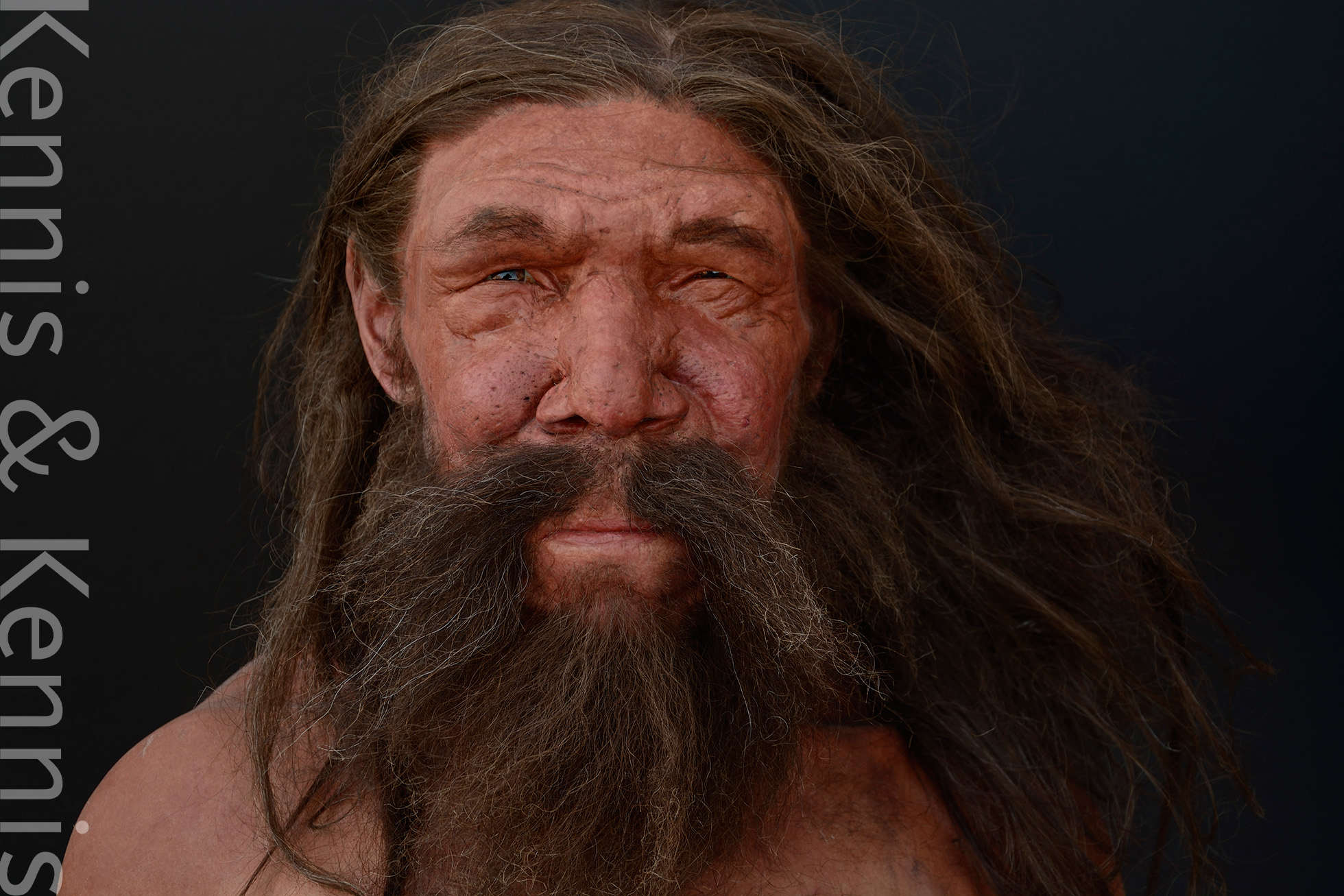
Altamura Man. Credit: Kennis & Kennis
En 2020 se publicó un nuevo estudio (Alessandro Riga et al), en este caso de su cavidad bucal estudiada in situ mediante un videoscopio, llegando a partes ocultas de la mandíbula y paladar, con los siguientes hallazgos:
- El individuo era de edad adulta, aunque no anciano.
- Había perdido dos dientes antes de morir y perdió otros cuatro post mortem.
- La dentición tenía un desgaste alto, lo cual produjo una lesión periapical en los dientes anteriores perdidos ante mortem, observada por rayos X.
- La dentición posterior tiene cierto grado de taurodontismo, y hay un espacio retromolar, dos características atribuidas al hipodigma neandertal.
- Sin embargo, se aprecia un rodete palatino (crecimiento anormal óseo en el paladar), lo que no se había observado antes entre neandertales.
También el neandertal de Altamura ha servido para aclarar buena parte del debate sobre las adaptaciones respiratorias de Homo neanderthalensis al clima frío, que tradicionalmente ha girado en torno a ciertos rasgos de la cavidad nasal interna considerados tradicionalmente autapomorfías de esta especie: una cresta medial vertical en la pared nasal interna, un engrosamiento medial adyacente y la supuesta ausencia de un techo óseo sobre el canal nasolagrimal. La limitación y fragmentación del registro fósil habían dificultado la verificación de estos rasgos, pero la nueva evidencia en el neandertal de Altamura permite descartarlos de manera sólida, aportando claridad sobre la morfología nasal neandertal y su significado adaptativo (Buzi et al., 2025).
The Altamura Neandertal
In 1993, a group of speleologists found a partial human skeleton at the end of the Lamalunga cave, near the small village of Altamura in southern Italy. It is embedded in a large calcite column on which coralloids have grown (small speleothems with coral shape). Its location gives it a unique and spectacular appearance, but makes its extraction extremely complex. Initially it was considered a Homo heidelbergensis, but in 2015 the analysis of its right scapula was presented, including the mitochondrial DNA that could be recovered from it, and that determined its assignment to Homo neanderthalensis.
It was dated to between 130-172 ka, which places it among the oldest known Neandertals. At that time, the megafauna on the area was composed of elephants, hippos, rhinos and deer. Its exceptional preservation in a «time capsule» could make possible to recover more genetic material, perhaps nuclear DNA, and if it can be extracted from the rock, that will enrich the knowledge about the morphological variability of the Neandertals.
In 2016, the skeleton was analysed in situ by means of laser scanner and high-resolution photogrammetry of the bones and the cave structure, and a complex digital reconstruction of the skull (a «virtual extraction») was developed, from two scanned parts and comparing with morphological elements of 38 other Middle and Upper Pleistocene specimens and modern humans (the closest skull was Saccopastore 1). Altamura has many Neandertal-like characteristics (midfacial prognathism, double-arched occipital torus, well-defined suprainiac fossa), but also plesiomorphic features (parietals angulated in coronal section, big mastoids, massive double supraorbital tori with a marked distinction between medial and lateral aspects). Considering the age of the fossil, the morphology of Altamura suggests that the archaic traits it retains may have been originated by geographic isolation of the early Neandertal populations from the Italian Peninsula (A. Profico et al, 2023).
Also based on the 2016 study, the Kennis brothers carried out an excellent reconstruction of the Man of Altamura.
A new study in 2020 (Alessandro Riga et al) analyses the oral cavity in situ by means of videoscope, reaching hidden parts of the mandible and palate, and providing the following findings:
- The individual was fully adult but not old.
- Two teeth were lost ante mortem and four were lost post mortem.
- The dental wear is marked. X-rays of the two lost anterior teeth show a periapical lesion, probably linked to the advanced dental wear.
- Some expression of taurodontism in the posterior dentition, and presence of a retromolar space, two features attributed to the Neandertal hypodigm.
- However, there is a well-developed palatine torus, (a bony protrusion on the palate), a feature not previously described in Neandertals.
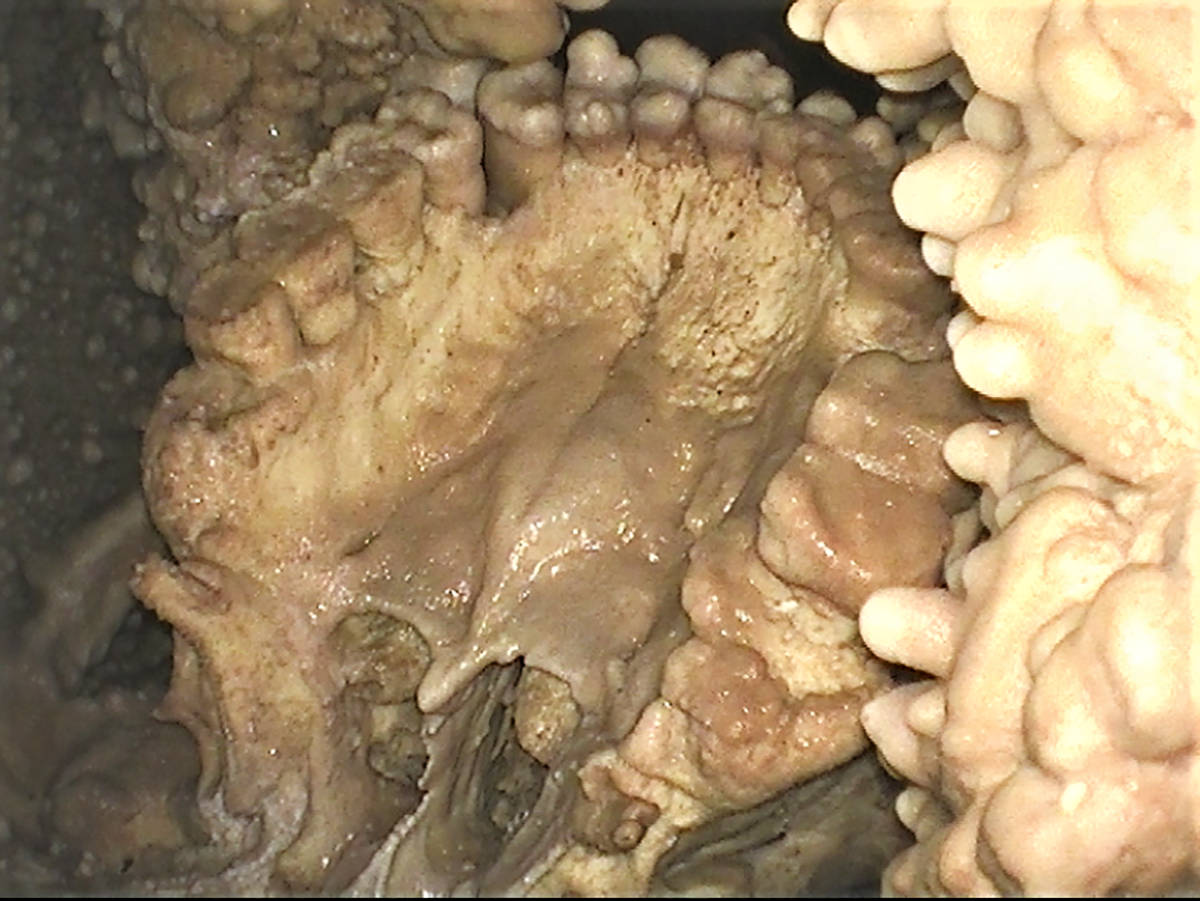
View of the maxillary dental arch and palate. Notice the well-marked bony exostosis (palatine torus). Credit: Riga A et al (2020)
The Altamura Neandertal has also helped clarify much of the debate on the respiratory adaptations of Homo neanderthalensis to cold climates, which has traditionally focused on certain inner nasal traits regarded as autapomorphies of the species: a vertically oriented medial projection on the inner nasal wall, a medial swelling adjacent to it, and the presumed absence of an ossified roof over the lacrimal groove. The scarcity and fragmentation of the fossil record had hindered verification of these features, but the new evidence from the Altamura Neanderthal allows them to be robustly ruled out, providing clearer insight into Neanderthal nasal morphology and its adaptive significance (Buzi et al., 2025).
Further information
- Profico, A., Buzi, C., Di Vincenzo, F. et al. (2023). Virtual excavation and analysis of the early Neanderthal cranium from Altamura (Italy). Commun Biol 6, 316.
- Di Vicenzo, F. et al (2018). Distinct among Neanderthals: The scapula of the skeleton from Altamura, Italy. Quaternary Science Reviews.
- Lar, M. et al (2015). The Neanderthal in the karst: First dating, morphometric, and paleogenetic data on the fossil skeleton from Altamura (Italy) Journal of Human Evolution.
- Riga A, Boggioni M, Papini A, Buzi C, Profico A, Di Vincenzo F, et al. (2020). In situ observations on the dentition and oral cavity of the Neanderthal skeleton from Altamura (Italy). PLoS ONE 15(12): e0241713.
 Nutcracker Man