Focus on the Sima de los Huesos

Probably in the next months we will have results about the nuclear DNA analysis of the hominid bones found in the Sima de los Huesos, dated to 430,000 years. I wanted to recap the background and importance of Sima, its findings, and what’s going on there at the present time.

Sima de los Huesos (‘Pit of Bones’) is one of the world’s most important sites of human fossils.  Located in Atapuerca, Spain, it is a sock-shaped pit with a 12 m deep vertical shaft, which turns into an inclined passage 10 meters in length, opening onto a 15 m2 chamber. So far, 7,500 hominin fossils have been found in this chamber… Sigue leyendo
Humor Evolution 2014

In Spain, Latin America and the Philippines, December 28th is a day for pranks, commemorating the biblical episode of The Massacre of the Innocents. This day is equivalent to the April Fool’s Day in the Anglo-Saxon countries.

To celebrate it, here is the top pranks around Human Evolution I have seen in this year 2014 😀

The Top 10 hominin #FossilFriday tweets of 2014

As we approach the end of the year, it’s time for summaries. This is my little contribution! From number 10 to 1, below is the list of my favorite #FossilFriday tweets in 2014.

For those who don’t know what «FossilFriday» means… Every Friday on twitter, scientists and interested amateurs share pics of their favorite fossils, related scientific papers or blog posts, by using the hashtag #FossilFriday. This is a great manner to show famous or rare pieces of museum collections, and to share research works. I usually join this and tweet about a different hominid fossil every Friday. Now, let’s start!  Sigue leyendo

Meet the Rhodesian Man

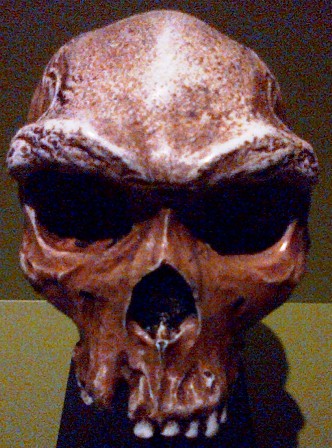
Widely known as Broken Hill 1 (also Kabwe 1), the Rhodesian Man is an almost complete cranium discovered on June 17th, 1921 in a lead and zinc mine, 18 meters below the ground level, at Broken Hill, Northern Rhodesia (now Kabwe, Zambia). It was sent in the same year to London, where it remains one of the key treasures of the Natural History Museum.

Kabwe 1 replica, NHM London. Photo: Roberto Sáez

This is a challenging specimen for the understanding of our African direct ancestors. However, the circumstances around the discovery do not help to define a precise dating to this fossil. It was found by a miner and there were no scientists around, so the initial collection of data was not the desirable: for example, the exact position and the relation to animal remains in the area. The discoverer had no clear memories of the finding. He explained that the surroundings were basically soft material, and the only few bones present were some bat bones plus a human tibia discovered one meter away on the same day. This likely corresponds to the same individual of the cranium.  Sigue leyendo

Summary of ‘The African Human Fossil Record’ symposium 2014

tahfrThe symposium »The African Human Fossil Record» in 2014 took place on 26-27 of September at Toulouse, France. This post summarizes a selection of topics presented in this meeting, in alphabetical order per author. By the way… look at the event logo on the right, really nice!

Beaudet A. et al

Some on-going studies try to determine the chronology of key sites in the Crandle of Humankind:

  • Swartkrans (first place where the co-ocurrence of early Homo and Paranthropus was recognized).
  • Kroomdraai (which yielded the type specimen of Paranthropus TM 1517).
  • Makapansgat (deposits of Australopithecus africanus remains dating to 3.0-2.6 MYA).

The initial results of the study show that Kromdraai dating could be closer to Makapansgat, thus older than previously thought, and that the deposits of Swartkrans are younger than 2 Ma.  Sigue leyendo