In 2014 we had in Spain the privilege of holding the XVII Congress of UISPP (Union International de Sciences Préhistoriques et Protohistoriques) in Burgos. The organiser was the Atapuerca Foundation, as a recognition of the decisive value that Atapuerca provides to the world of Prehistory, Archaeology and Paleoanthropology.
At the time, this was the Congress with the highest number of scientific articles submitted ever in the history of UISPP: 2,000 articles presented by 3,000 authors.
Atapuerca is one of the most relevant sites for human evolution in the world, probably the most important one for the last half-million years period. Some key figures below can support this statement.
Sima de los Huesos site in Cueva Mayor:

- A total of 7,500 fossils found so far, belonging to 29 individuals of the same population from 430,000 years ago.
- They are ancestor of Neandertals. For one decade this population was assigned to the species Homo heidelbergensis, but the extended study of this huge fossil record discarded this assignment.
- 17 skulls found. One of them is the most complete skull of a Middle Pleistocene Homo: Cranium number 5 (‘Miguelón’)
- The most complete pelvis in the fossil record, called ‘Elvis’.
- Sima also provided some tiny bones of the middle ear, really strange to find.
- The enormous number of fossils contrast with the area they are buried in Sima. Only 20 centimeters are excavated from a 1 m2 area every season.
- Only in 2014 200 hominin fossils have been found. This figures doubles the total number of human fossils extracted from the rest of sites worldwide.
- Since the beginning of excavations in 1978, the Sima has provided more than half of the Homo fossils worldwide.
Gran Dolina has provided more than 100 fossils of 6 individuals from 800,000 years ago classified as a new species, Homo antecessor. They are one of the largest set of the oldest fossils in Western Europe.
Sima del Elefante has provided one of the oldest human fossils in Western Europe, dated to 1.3 million years.
Not only Paleolithic but Atapuerca also has more than 200 Neolithic sites in a 314 km2 area.
Overall, Atapuerca shows a human occupation since 1.3 million years B.P. until Roman age in the 4th century.

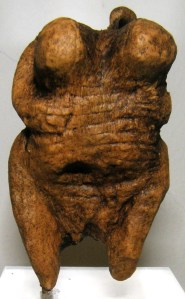 ut a mammoth-ivory figurine found in 2008 in the basal Aurignacian deposit at Hohle Fels Cave, Germany. It was made between 35-40,000 years BP. It is the oldest portable art piece found in Europe and one of the oldest artworks in general. Below are some hypotheses around the meaning of this piece (some of them are in turn applicable to most Paleolithic Venus!):
 The 4th annual meeting of the European Society for the study of Human Evolution (ESHE) took place in Florence, Italy (Sep 18th-20th). This is one of the top conferences we can see in Europe for this field.
 Nutcracker Man