

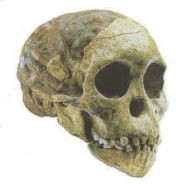
La Ferrassie-1 Neandertal. Photo: Roberto Sáez
The extinction of Neandertals is a huge challenge for paleoanthropologists. Neandertals and modern humans are believed to have evolved from a common ancestor about 500,000 years ago. Some researchers usually thought of Homo heidelbergensis as this common ancestor, but other hypothesis suggests that Homo heidelbergensis existed as an species only in an European niche, whilst there is a new parent species yet to be found. In any case, the ancestor evolved into Neandertals in Europe and Homo sapiens in Africa. Neandertals lived in Eurasia 200,000 years before Homo sapiens arrived from Africa. About 60,000 years ago, succesful migrations of African modern humans came into Eurasia and then also quickly to Western Europe. It is not known when they first met Neandertals, but genetic evidence shows interbreeding between both species in different periods.
A study by Tom Higham et al set the extinction of the last Neandertals around 40,000 years ago. It is based on radiocarbon dating from 40 sites across Europe. Assuming that Homo sapiens first reached Europe about 45,000 years ago, this implies a period of Neandertals & sapiens coexistence of between 5,000 and 10,0000 years.
However, the study does not include remains from Gorham’s Cave in Gibraltar, where Neandertals apparently survived until c. 30,000 years ago.

 Nutcracker Man