
The origin of music is often linked to the cognitive explosion of Homo sapiens around 50,000–60,000 years ago, evidenced by the appearance of cave paintings, ornaments and burials.
As part of broader artistic and symbolic expression, music may have contributed to maintaining larger social networks and to the expansion of modern human groups.
What was early music used for? Some proposed functions include:
- Religious rituals
- Recreation
- Motivational activities
- Group identity and cohesion
- Communication and coordination
- Aid in hunting
What is the oldest evidence?
1) Percussion instruments
The oldest evidence may be found in the archaeological site of Mezin (Ukraine): a set of mammoth bones (scapula, femur) painted with red ochre and a reindeer antler hammer, with signs of repetitive surface damage on all of them. Some interpret these bones as musical instruments. They are dated to 24,000 years.

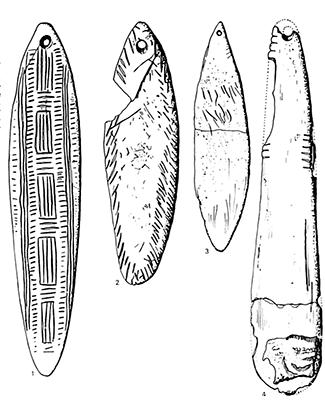
Other instruments are the ‘bullroarers’ which we find in the Solutrean and Magdalenian periods:
2) String instruments
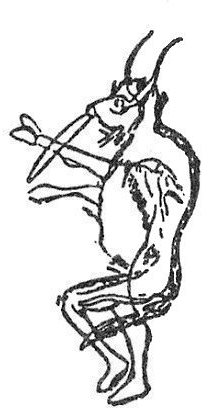
The organic materials are not preserved so the only ancient clues are found in rock art, like a sorcerer with a musical bow in the Trois-Frères cave (France), dated to 13,000 years. However, some authors consider that the sorcerer actually holds a flute.
The actual oldest piece is a plucked string instrument known as the ‘se’, dated to 2,700 years, found in Hubei Province, China. That was a board instrument fitted with 25 strings of twisted silk, which was used by the elite in rituals and sacrificial offerings. Only half of the base was recovered but showing clear evidence of the holes for the strings. At the same site, some rests of a percussion instrument called ‘bianzhong’ were found: a 4.7 m frame for housing bronze bells plus seven bases of the bells.
These 2,000-year-old deer antlers from Go O Chua, Vietnam, are thought to have been used as primitive chordophones, a type of stringed instrument that were once used in the region’s court life, as well as for traditional music. There is a round hole at the end of one antler, which may have been made to fix a peg used to tune a string. The antler also appears to have a polished bridge to support the string. On the other, broken, antler, there are grooves where a taut string might have once been attached.

3) Wind instruments
Flutes and whistles are more clearly evidenced in the archaeological finds. Below are some remarkable examples:
Divje Babe Cave, Slovenia
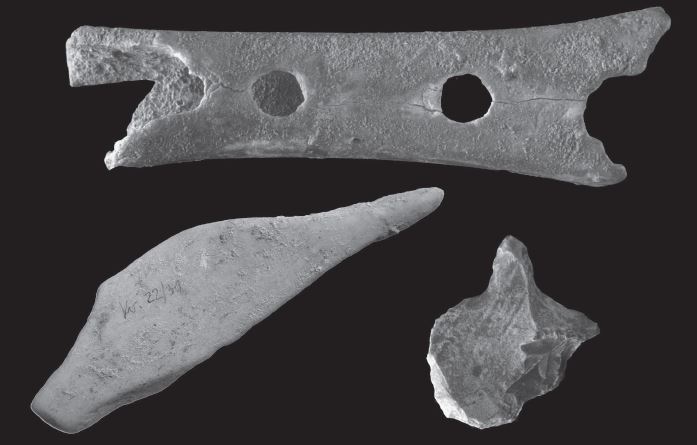
One flute found in 1995. It is a fragment of the femur of a cave bear, pierced with three spaced holes. It is dated to ~43,000 years. A different hypothesis says the holes lack tool marks and instead were made by an animal chewing. However, the separation between the holes is singular and the instrument can produce diatonic sounds.
Geissenkloesterle Cave, Germany
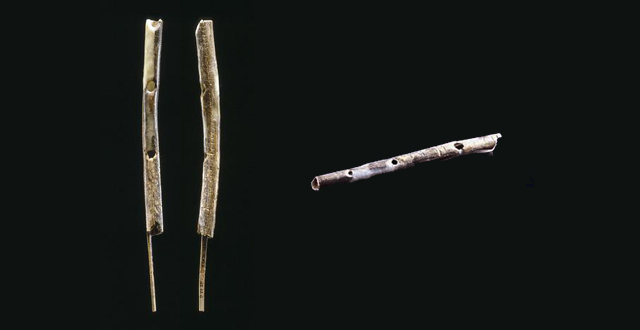
Two flutes published in 2012, dated to the Early Aurignacian (at least 35,000 years by radiocarbon and 36,000 years by thermoluminiscence). One was shaped from a swan’s ulna bone. It is 12 cm long but thought to be 17 cm long originally. It has three holes and produce four notes. The other flute was shaped from ivory.
These findings support the hypothesis that the Danube River served as a key migration corridor into Central Europe earlier than previously thought.
Hohle Fels, Germany
Only a few weeks after publishing the famous oldest European ‘venus’ figurine from Hohle Fels cave system, various fragments of flutes from the same system were discovered in 2008 and published in 2009. It is dated to 35,000-43,000 years.
One of them was successfully rebuilt almost entirely from 12 fragments. It is 21,8 cm long and was made with the radius of a griffon vulture wing. It has 5 holes and a V-shaped mouthpiece with 2 small clefts.
Other small pieces were found at Hohle Fels, very fragmented but likely belonging to two other flutes. A third piece was found in the nearby site of Vogelherd.
All of them are made of ivory, which requires much more effort to shape than bird’s bones.
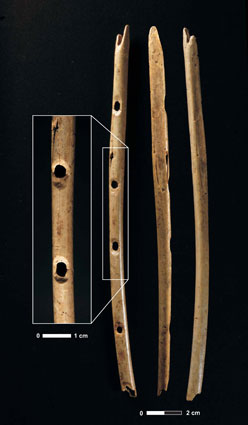
La Güelga, Spain
A phalangeal whistle was found in an Aurignacian level, dated to 30,000-34,000 years. Also from this cave is a fragment of flute from the Magdalenian period.
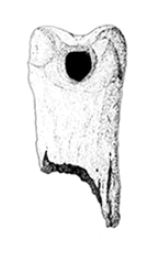
Isturitz, France
22 fragments of flutes made from swan wing bones, 8 of them are quite complete. They were published in 1991, dated to 26,000-32,000 years.

Eynan-Mallaha, Israel
Among a collection of 1,100 bird bones collected from this Natufian site in the 1950s, six of them have been found to be flutes, one of them intact, measuring 6.5 cm. They are dated to 12 ka. When played, the flute emits a high-pitched sound similar to that of some birds of prey, as can be seen in the video below:
Jiahu, China
A set of 30 flutes made from hollowed bird bones, dated to 9,000 years. They have between 5 and 8 holes and one of them is still playable.

Cave of Marsoulas, France
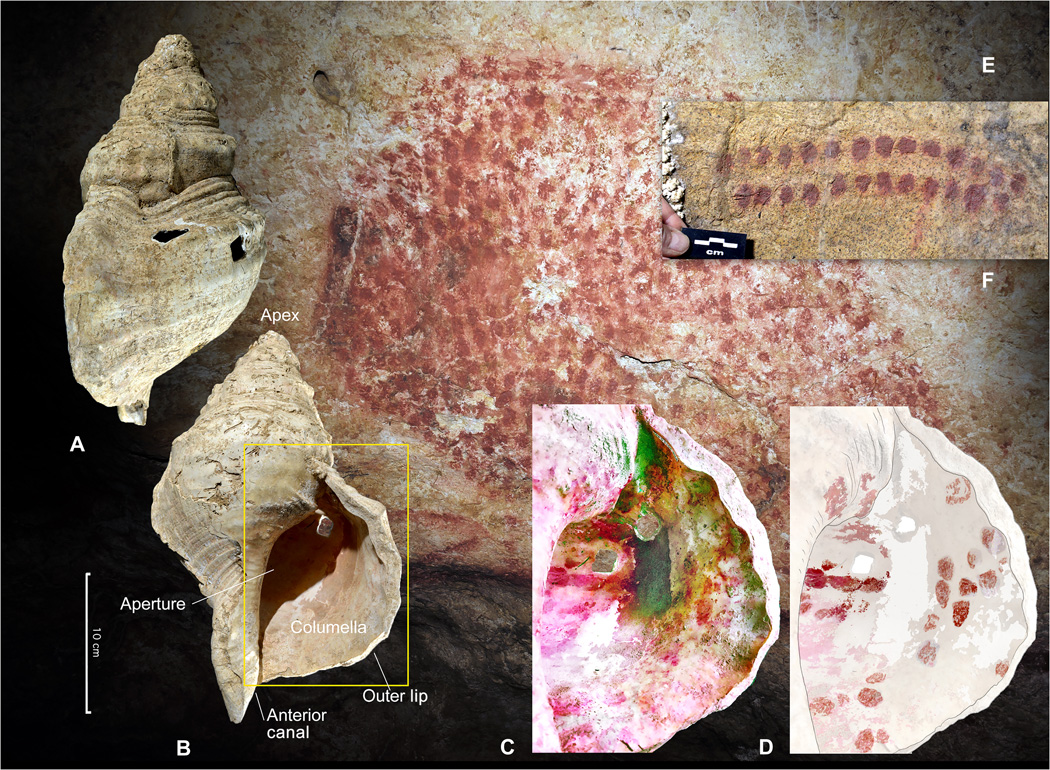
A seashell found in the decorated cave of Marsoulas had been modified into a wind instrument by the Magdalenian occupants of the site, around 18,000 years ago. This is one of the very rare examples, if not the only one for the Paleolithic period, of a musical instrument fashioned from a large shell, and the first conch shell of this use thus far discovered. It was forgotten for more than 80 years after its collection at the cave entrance, until a detailed analysis showed considerable transformations made to enable it to be blown.
 Nutcracker Man
Pingback: Najstarsze instrumenty świata | Ethnotrans
Pingback: En Eski 10 Müzik Enstrümanı - Evrimsel Antropoloji
Hm me encanta este post y lo compartiría en el face con mucho gusto si no hubieras metido a Divje Babe. Cariño. 😉
Me gustaLe gusta a 1 persona
Pingback: Interessante Links und Nachrichten 19.11.2018ff - Aleks Weltweit
Pingback: Wondering about “the [music] of [human beings for the last 60,000 years]” | On anthropology, education, culture, and more …
Pingback: Unveiling the Musical Past: Tracing the Presence of the Jaw Harp in Medieval Times | Dvaita
Pingback: 8 Intriguing Facts about Prehistoric People - ScienceGonnaGetYou
Pingback: Oldest Musical Instruments in History - The Mystic Keys
Pingback: Instrumentos de percussão - Musicloom