
[English version below]
Solemos conocer pocas novedades sobre australopitecos, y menos aún sobre los parántropos, un género asombroso por lo exageradas que nos parecen determinadas partes de su morfología craneal (dentición poscanina, cresta sagital, cara proyectada y con forma cóncava…). La hipótesis más aceptada es que esta morfología masiva responde a una especialización de la masticación repetida de vegetales duros o abrasivos. Pero hay menos claridad respecto a cuál es el origen de estos seres y a su relación con las formas de Australopithecus y de Homo con las que podrían haber llegado a compartir no solo rango temporal sino también, al menos con Homo, un mismo paisaje.
Por ahora, la hipótesis más aceptada es la de una relación filogenética de los parántropos con alguna rama de australopitecos, de modo que estas formas robustas y los primeros representantes de nuestro género Homo son clados hermanos. En un nuevo trabajo recientemente publicado, José Braga y otros (2023) profundizan en este aspecto a partir de cuatro individuos infantiles de Paranthropus robustus, especie que por el momento sólo se conoce en varios yacimientos sudafricanos de la llamada «Cuna de la Humanidad». Tres de los especímenes analizados proceden de Kromdraai unidad P (KW 6420, KW 9000/9600 y KW 10840) y uno de Drimolen (DNH 47). Los autores encuentran que, en muchos rasgos craneales, la ontogenia de Paranthropus robustus es más próxima a la de Homo que a la de Australopithecus africanus. Algunos detalles de este trabajo son los siguientes:
- Aunque la mayoría de los rasgos craneofaciales robustos distintivos aparecen relativamente tarde en la ontogenia, esto no se da de igual forma en todo el cráneo.
- La cara en desarrollo de P. robustus tenía patrones de crecimiento premaxilares y maxilares separados, como ocurre en los humanos modernos y en los simios africanos.
- El desarrollo de un esqueleto facial posterior muy alto, con una región posterior del paladar profunda, están probablemente asociados al gran engrosamiento progresivo del paladar característico de la ontogenia de P. robustus.
- El sistema masticatorio en P. robustus no alcanza su forma adulta en el momento de la aparición del primer molar: antes de la emergencia del M1, tanto en A. africanus (Niño de Taung) como en P. robustus (KW 9000), el refuerzo de la cara anterior lateral de la abertura nasal permitía la transmisión de fuerza desde los dientes anteriores deciduos que estaban ya desgastados.
- En definitiva, mientras que algunas características de la cara adulta de robustus son evidentes antes de la aparición del primer molar, como la posición del cigomático-maxilar y los pilares anteriores, otras no lo son, como el grosor del paladar. Este patrón mixto también se observa en especímenes australopitecinos del sur de África.
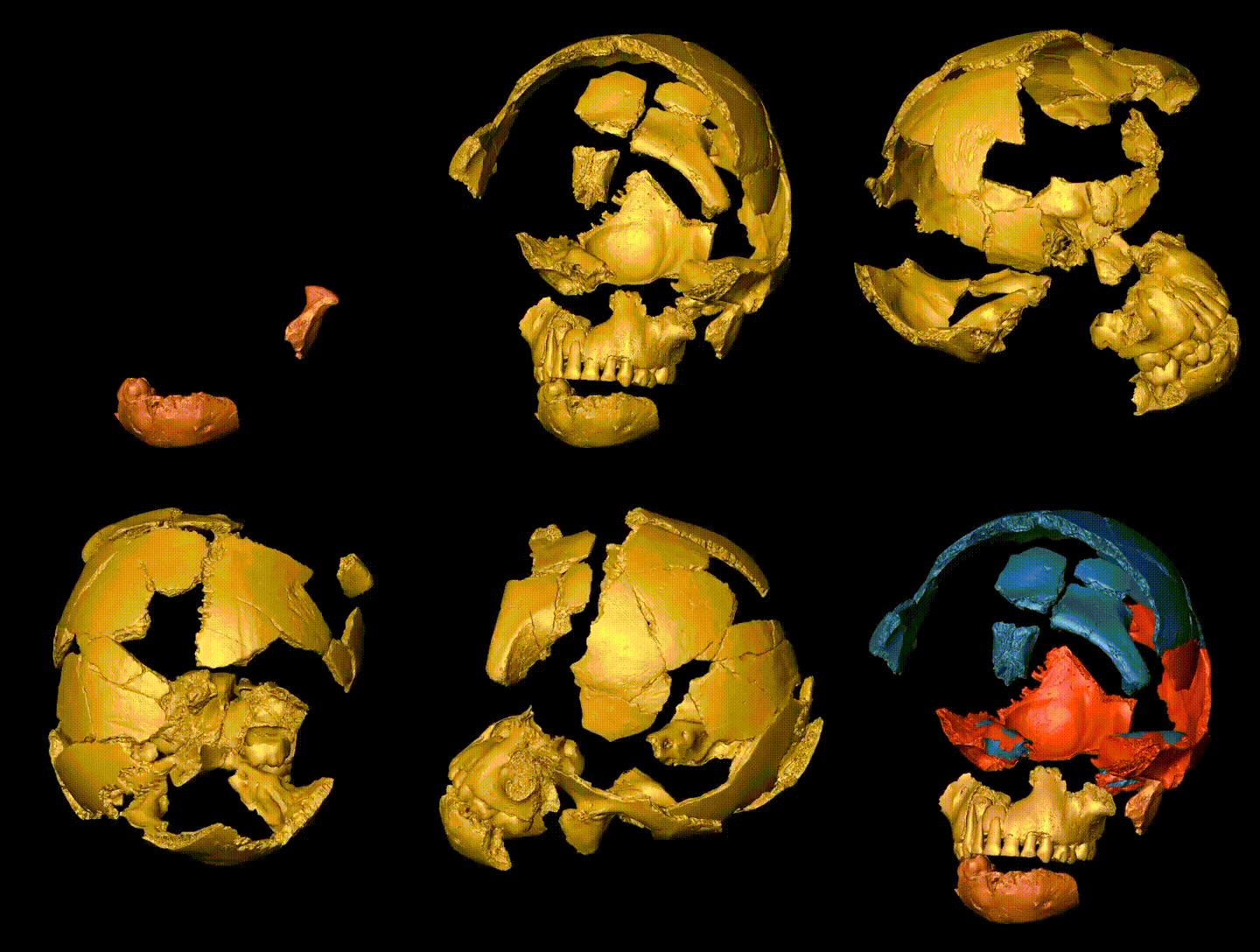
Reconstrucción de un cráneo infantil de Paranthropus robustus. Crédito: José Braga et al (2023)
Parántropos y primeros humanos, clados hermanos
Este trabajo también observa que la fosa cerebral posterior es proporcionalmente más grande y más rotada posteroinferiormente (hacia abajo) en los individuos infantiles de P. robustus (KW 1080) que en los de Au. africanus (Taung) y en los chimpancés y bonobos.
Esta característica es compartida con el género Homo, lo cual podría ser resultado de una homoplasia (cambio evolutivo paralelo, que da lugar a un mismo carácter adquirido independientemente), aunque las marcadas diferencias en esta región entre los juveniles de P. robustus y A. africanus son más consistentes con sinapomorfias (rasgo derivado a partir de la evolución desde un ancestro común).
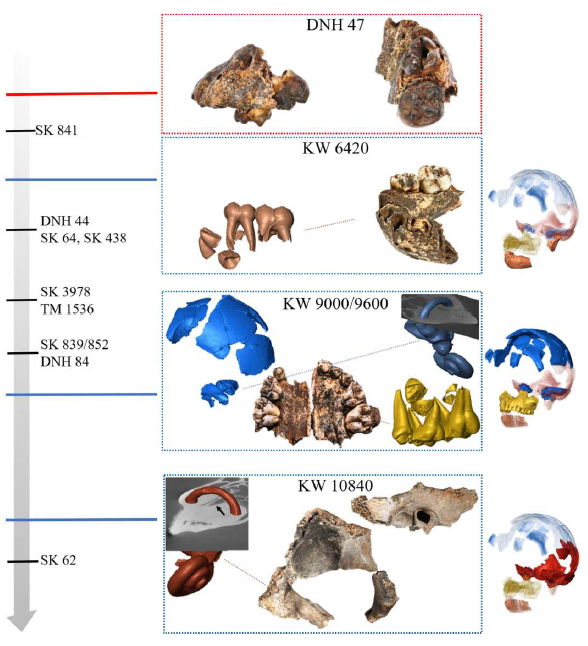
Cuatro individuos infantiles de Paranthropus robustus: tres de Kromdraai (KW 6420, KW 9000/9600, and KW 10840) y uno de Drimolen (DNH 47). Crédito: José Braga et al (2023)
Hominino cazado por un leopardo
La calota SK 54 de un hominino juvenil de Swartkrans Member 1 (1,8-1,9 Ma) es famosa porque tiene dos marcas de punción provocadas por los caninos inferiores de un leopardo, probablemente cuando lo arrastró a su lugar de alimentación, como un árbol. De hecho, las marcas encajan bien con los caninos de la mandíbula SK 349 hallada en el mismo depósito.
Tradicionalmente, SK 54 se ha atribuido a Paranthropus. Sin embargo, SK 54 carece de la morfología supraorbitaria adulta distintiva de P. robustus, que está presente en miembros juveniles de ese taxón, como KW 9600. Por el contrario, la escama frontal más orientada verticalmente y la constricción postorbital más débil de SK 54 se aproximan a las del Homo erectus infantil de Modjokerto, de la isla de Java (Indonesia). Su posible atribución a Homo también es argumentada por Andy I. R. Herries y otros (2020) y por Jesse M. Martin y otros (2022). Si SK 54 pertenece a Homo, se abre la interesante posibilidad de comparar el crecimiento neurocraneal entre especímenes juveniles de Homo africanos y asiáticos.
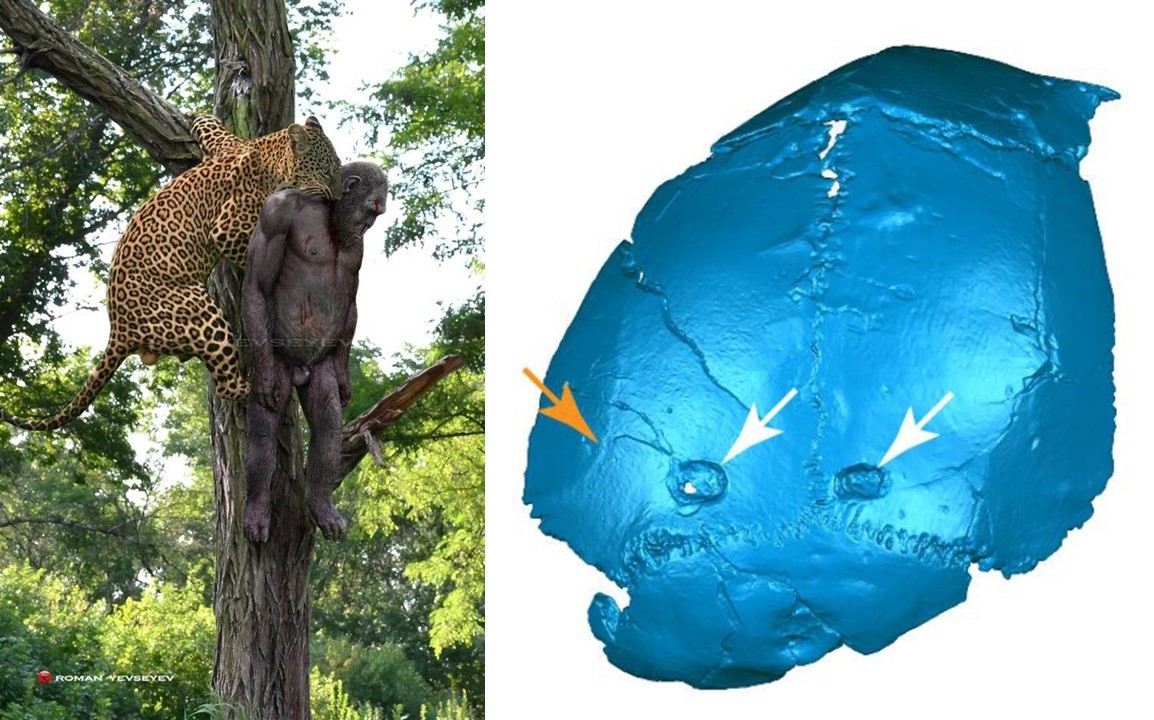
Calota de SK54 (crédito: Jesse M. Martin et al, 2022) y reconstrucción artística (crédito: Roman Yevseyev)
Ontogeny of paranthropines, more similar to that of humans than to that of australopithecines
We usually know little new about australopithecines, and even less about paranthropines, an amazing genus because of the various exaggerated parts of their cranial morphology (postcanine dentition, sagittal crest, projected and concave-shaped face…). The most accepted hypothesis is that this massive morphology responds to a specialization of repeated chewing of hard or abrasive vegetables. But there is less clarity regarding the origin of these beings and their relationship with the forms of Australopithecus and Homo with which they could have shared not only temporal range but also, at least with Homo, the same landscape.
For now, the most accepted hypothesis is that of a phylogenetic relationship of paranthropines with some branch of australopithecines, so that these robust forms and the first representatives of our genus Homo are sister clades. In a new paper recently published, José Braga et al. (2023) further explores this aspect based on four infant individuals of Paranthropus robustus, a species only known for the moment from several South African sites in the so-called «Cradle of Humankind». Three of the analyzed specimens come from the Kromdraai P unit (KW 6420, KW 9000/9600 and KW 10840) and one from Drimolen (DNH 47). The authors find that, in many cranial features, ontogeny of Paranthropus robustus is closer to that of Homo than to that of Australopithecus africanus. Some details of this work are as follows:
- While most distinctive robust craniofacial features appear relatively late in ontogeny, this does not occur equally throughout the skull.
- The developing P. robustus face comprised separate premaxillary and maxillary growth modules, as is the case in modern humans and African apes.
- The development of a very tall posterior facial skeleton, with a deep posterior palate, are probably associated with the notable progressive palatal thickening characteristic of P. robustus ontogeny.
- The masticatory system in P. robustus does not reach its adult form at the time of the emergence of the first molar: before M1 emergence, in both A. africanus (Taung Child) and P. robustus (KW 9000) buttressing of the anterior face lateral to the nasal aperture would have allowed force to be transmitted from the heavily worn anterior deciduous teeth.
- Ultimately, while some features (e.g., the location of the zygomaticomaxillare and the anterior pillars) of the adult Paranthropus face are evident before M1 emergence, others (e.g., palatal thickness) are not. This mixed pattern is also observed in australopithecine specimens from southern Africa sites.
Paranthropines and early humans, sister clades
This work also observes that compared to juvenile A. africanus (Taung) and chimpanzees/bonobos, KW 10840 has a relatively enlarged and more inferiorly rotated posterior cerebral fossa.
This feature is shared with the genus Homo, which could be the result of homoplasy (parallel evolutionary change, resulting in the same independently acquired character), but the marked differences in this region between juvenile P. robustus and A. africanus are consistent with the similarities between Paranthropus and Homo being synapomorphies (traits derived from evolution from a common ancestor).
Hominin hunted by a leopard
The SK 54 calota of a juvenile hominin from Swartkrans Member 1 (1.8-1.9 Ma) is famous because it has two puncture marks caused by the lower canines of a leopard, probably when it dragged it to its feeding site, such as a tree. In fact, the marks conform well to the canines of leopard fossil jaw SK 349 from the same deposit.
Traditionally, SK 54 has been attributed to Paranthropus. However, the SK 54 juvenile cranium lacks the distinctive adult supraorbital morphology of P. robustus that is present in relatively young juvenile members of that taxon, such as KW 9600. In contrast, the more vertically oriented frontal squama and weaker postorbital constriction seen in SK 54 are closer to the morphology exhibited by the juvenile Homo erectus from Modjokerto in Java, Indonesia. Its possible attribution to Homo is also argued by Andy I. R. Herries et al. (2020) and Jesse M. Martin et al. (2022). If SK 54 belongs to Homo, then this opens the interesting possibility of detailed comparisons of neurocranial growth between juvenile Homo specimens from southern Africa and Asia.
 Nutcracker Man
Muy interesante, soy una científica que la investigación es lo primordial.Exelente nota.
Me gustaLe gusta a 1 persona
Excelente trabajo, esto es a lo que en tiempos de estudiante secundario escuché que los humanos actuales nos comimos a los anteriores en evolución o sea al eslabón o eslabones perdido.
Me gustaMe gusta