
[English version below]
Actualizado septiembre 2025
Parece que ha pasado más tiempo, pero han sido pocos años desde que conocimos a la especie Homo naledi en septiembre de 2015. Naledi es un nombre africano que viene de la tribu sudafricana de Sesotho y significa «estrella», por la denominación Rising Star del sistema de cuevas donde se descubrió. Desde entonces, el registro fósil de esta especie se ha ido enriqueciendo, y se compone de más de 2000 huesos y dientes, que representan a un mínimo de 15 individuos.
Su datación es de 241-335 ka (miles de años), una antigüedad parecida a la de los primeros especímenes de Homo sapiens en África. Estos otros humanos, Homo naledi, eran pequeños (150 cm y 45 kg) y también tenían un cerebro llamativamente pequeño (466-560 cc) en comparación con otras especies humanas: Homo erectus (entre 727-1220 cc), Homo sapiens (1350 cc como promedio), Homo neanderthalensis (1450 cc como promedio). Se trata de un tamaño en un rango similar al cerebro de Homo floresiensis (426 cc).
Homo naledi es una asombrosa especie, que tendría muy cerca a otros grupos humanos en el mismo paisaje, pero que se distinguiría de ellos notablemente en su tamaño corporal y en su cabeza. Pero ¿y en su inteligencia? ¿Cómo podemos «medir» la inteligencia de aquellos humanos con un cerebro pequeño?
Para tomar pistas, tenemos que volver a las cuevas de Rising Star. Allí tenemos al menos una veintena de cuerpos en el fondo de un conjunto de galerías complejas, algunas realmente estrechas, sin ninguna evidencia arqueológica que indique que aquellos homininos vivían en esas cámaras. Los estudios geológicos no han hallado otras posibles aperturas antiguas hacia aquellos lugares; parece que el acceso a ellos nunca fue fácil. Es más, pocos restos de otros animales se han hallado allí dentro, por ejemplo, de búho.
Así, la hipótesis que se maneja es la del depósito deliberado de los cuerpos en aquellos lugares complicados, lo que ha llevado a trabajar en dos cuestiones durante los últimos años:
1) ¿Pudo tener aquel depósito un carácter simbólico?
2) ¿Emplearon fuego, para poder realizar semejante actividad en la profundidad de la cueva?
Veamos lo que conocemos a día de hoy sobre estas cuestiones.
¿Homo naledi enterraba?
Se han descubierto varias zonas distintas con datos geológicos y anatómicos que sugieren la remoción de tierra para cavar hoyos y depositar a los cuerpos de Homo naledi flexionados.
En la cámara Dinaledi, una concentración de huesos (Dinaledi Feature 1) contiene 83 partes identificables del cuerpo de un adulto y, sobre él, varias de otro individuo (al menos tres fragmentos en contacto con el cuerpo anterior). Además, una segunda concentración (Dinaledi Feature 2) está separada 20 cm de la primera y parece ser de un individuo juvenil, pero está pendiente de excavar.
En la antecámara Hill, contigua a Dinaledi, existe otra concentración de 90 fragmentos óseos y 51 dientes, que pertenecen a 4 individuos infantiles, de los que la conservación de uno de ellos parece indicar que estaba en posición flexionada y que tendría unos 13 años de edad al morir. En su mano o cerca de ella, hay una interesante roca con estrías o líneas de posible modificación o desgaste, que está en estudio. Además, está el esqueleto parcial de otro infantil, y los cráneos parciales de otros dos.
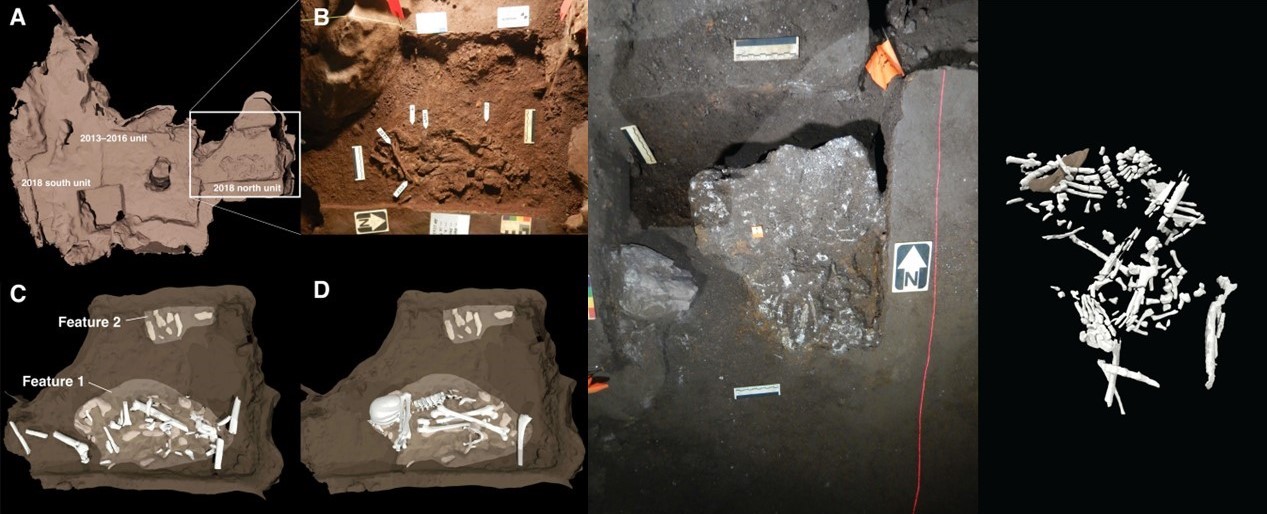
(1,2) Dos zonas de enterramiento en la cámara Dinaledi. (3,4) Zona de enterramiento en la antecámara Hill. Crédito: Berger L. et al., 2023. | Rising Star program | National Geographic
Lee Berger y colaboradores concluyen que el enterramiento cultural es la opción que mejor se ajusta a las distintas evidencias de cuerpos enteros ingresados en el subsistema, elementos articulados lejos de cualquier punto de entrada, falta de marcas de carnívoros y entorno de cueva seca que descarta el arrastre por agua. Muchos de los huesos articulados muestran signos de perturbación cercana, que los autores interpretan como causadas por excavaciones posteriores, tal vez buscando nuevas ubicaciones para enterramientos. Desde la fase de preprint, esta publicación ha pasado por dos años de escrutinio público, aparte de la necesaria revisión por pares. En este sentido, Martinón-Torres et al. (2023) indican que las evidencias científicas son insuficientes como para afirmar que Homo naledi enterrara a sus muertos o creara arte rupestre. Asimismo, Foecke et al. (2024) encuentran problemas en los métodos empleados para la toma de datos, cuantificación, análisis, visualización e interpretación de los datos geoquímicos y sedimentológicos.
El siguiente vídeo (en Berger et al., 2025) ofrece un recorrido en realidad virtual aumentada por la antecámara Hill y la cámara Dinaledi:
Estos enterramientos de Homo naledi habrían sucedido al menos 160 ka antes que los enterramientos sapiens de Panga ya Saidi en Kenia (~78 ka), y de Qafzeh y Skhul en Israel (~100 ka), y son 100-200 ka posteriores al depósito de Sima de los Huesos (preneandertal). Lo que tenemos en Rising Star es la acumulación de un número muy alto de cuerpos, incluyendo los hallados en excavaciones anteriores. Homo naledi pudo haber empleado distintas zonas de Rising Star para realizar actividades funerarias, a pesar de su pequeño cerebro. Está claro que este comportamiento cultural complejo no estaba del todo vinculado al mero tamaño cerebral.
¿Homo naledi hacía grabados simbólicos?
Se han descubierto numerosos grabados, la mayoría de trazados geométricos con líneas entrecruzadas, algunos muy profundos, que recuerdan al grabado en forma de «hashtag» dejado mucho después por los neandertales en Gorham’s Cave.
Fueron realizados sobre un pilar de la antecámara Hill que se extiende por la fisura natural del pasaje que une Hill con Dinaledi. Hay un conjunto de al menos 46 grabados (panel A), pero hay otros dos paneles B y C con más grabados pendientes de estudio, algunos de los cuales parece que podrían incluso tener alguna sustancia aplicada sobre ellos.
Aunque no se puede tener certeza de su autoría y datación, se considera improbable que otro hominino distinto a Homo naledi pudiera haberlos hecho, por la ausencia de otras evidencias físicas y culturales.
De nuevo, se trataría de una antigüedad fascinante para este tipo de representaciones simbólicas, con permiso de la concha grabada por Homo erectus en Java hace medio millón de años. En este caso, la revisión del estudio está todavía en curso.

(1,2) Grabados en forma de «hashtag». (3) Grabado no geométrico. (4) Roca con líneas y estrías hallada cerca de la mano de un Homo naledi en la antecámara Hill. Crédito: Berger L. et al., 2023. | Rising Star program | National Geographic
¿Homo naledi controlaba el fuego?
En diciembre de 2022, Lee Berger adelantó en una conferencia impartida en la Carnegie Institution of Science in Washington, D.C., el hallazgo de restos de pequeñas hogueras y manchas de hollín en distintas paredes y techos de pasajes y cámaras de Rising Star. También debemos esperemos la publicación científica de este hallazgo.

Hueso quemado, carbón y ceniza encontrados en Rising Star, Sudáfrica. Crédito: Crédito: Berger L. et al., 2023. | Rising Star program | National Geographic
¿Extraña todo esto? No mucho. A pesar de su pequeño tamaño, el endocráneo de Homo naledi comparte varios aspectos estructurales con otras especies de Homo, que no se encuentran en otros homininos o grandes simios, especialmente relacionados con la organización de los giros frontales inferiores y orbitales laterales (R. Holloway et al, 2018). Habrá que esperar a la revisión por pares de estos nuevos trabajos. Con lo que queda por excavar y estudiar, podríamos esperar más datos que indiquen la capacidad cognitiva chocante de un humano con un cerebro poco mayor que el de un chimpancé.
Referencias
- Berger L. et al. (2025). Evidence for deliberate burial of the dead by Homo naledi
- Berger L. et al. (2023). 241,000 to 335,000 years old rock engravings made by Homo naledi in the Rising Star Cave system, South Africa
- Fuentes A. et al. (2023). Burials and engravings in a small‐brained hominin, Homo naledi, from the late Pleistocene: contexts and evolutionary implications
Más información
- Quick summary about Homo naledi | Nutcracker Man
- New Evidence Suggests Intentional Burials and Use of Symbols by Other Hominins Hundreds of Thousands of Years Before Homo sapiens | National Geographic Society Newsroom
- A mysterious human species may have been the first to bury their dead | National Geographic
Burials and cave engravings made by Homo naledi?
Updated September 2025
It seems like more time has passed, but actually it has been a few years since we first met the species Homo naledi in September 2015. Naledi is an African name that comes from the South African Sesotho tribe and means «star», after the Rising Star designation of the cave system where it was discovered. Since then, the fossil record of this species has grown, and is composed of more than 2000 bones and teeth.
It is dated to 241-335 ka (thousands of years), an age similar to that of the earliest specimens of Homo sapiens in Africa. These other humans, Homo naledi, were small (150 cm and 45 kg) and also had a surprising small brain (466-560 cc) compared to other human species: Homo erectus (between 727-1220 cc), Homo sapiens (1350 cc on average), Homo neanderthalensis (1450 cc on average). They have a brain size in a similar range to the brain of Homo floresiensis (426 cc).
Homo naledi is a striking species, which would have been very close to other human groups in the same landscape, but which would be notably different from them in its body size and its head. But what about their intelligence? How can we «measure» the intelligence of those humans?
To take clues, we have to go back to the Rising Star caves. There we have around twenty bodies at the bottom of a set of complex galleries, some really narrow, without any archaeological evidence to indicate that those hominins lived in those chambers. Geological studies have not found yet any other possible ancient openings to these places; it seems that access to them was never easy. Moreover, few remains of other animals have been found there, for example, owls.
Thus, the hypothesis that is handled is that of the deliberate deposit of the bodies in those complicated places, which has led to work on two questions during the last years:
1) Could that deposit have had a symbolic character?
2) Did they use fire to carry out such an activity in the depths of the cave?
The following post summarises what we can know as of today about these questions.
Did Homo naledi bury their dead?
Several distinct burial areas have been discovered, with geological and anatomical evidence suggesting the removal of soil to dig holes and the deposit of flexed Homo naledi bodies.
In the Dinaledi Chamber, one bone concentration (Dinaledi Feature 1) contains 83 identifiable body parts of an adult and, above it, several of another individual (at least three fragments in contact with the previous body). In addition, a second concentration (Dinaledi Feature 2) is separated 20 cm from the first and appears to be from a juvenile individual, but remains to be excavated.
In the Hill Antechamber, adjacent to Dinaledi, there is another concentration of 90 bone fragments and 51 teeth, belonging to 4 infantile individuals, of which the preservation of one of them allows us to determine that it was in a flexed position and that it would have been about 13 years old at the time of death. In his hand or near it, there is an interesting rock with serrations or lines of possible modification or use of wear, which is under study. In addition, there is the partial skeleton of another infant, and the partial skulls of two others.
Lee Berger and colleagues conclude that cultural burial is the option that best fits the various evidences: whole bodies found in the subsystem, articulated elements far from any entry point, lack of carnivore marks, and a dry cave environment that rules out water drag. Many of the articulated bones show signs of nearby disturbance, which the authors interpret as being caused by subsequent excavations, perhaps in search of new burial sites. Since the preprint phase, this publication has undergone two years of public scrutiny, in addition to the necessary peer review. In this regard, Martinón-Torres et al. (2023) indicate that the scientific evidence is insufficient to claim that Homo naledi buried its dead or created rock art. Likewise, Foecke et al. (2024) find problems in the methods used for data collection, quantification, analysis, visualisation, and interpretation of geochemical and sedimentological data.
These burials would have occurred at least 160 ka before the sapiens burial at Panga ya Saidi in Kenya (~78 ka), and the ones at Qafzeh and Skhul in Israel (~100 ka), and 100-200 ka later than the deposit at Sima de los Huesos (pre-Neandertal). What we have at Rising Star is the accumulation of a very high number of bodies, including those found in earlier excavations. Homo naledi may have employed different areas of Rising Star for funerary activities, despite its small brain. It is clear that this complex cultural behavior may have not been necessarily linked merely to brain size.
Did Homo naledi make symbolic engravings?
Numerous engravings have been discovered, mostly geometric representations with intersecting lines, some of them very deep, and reminiscent of the «hashtag» engraving left much later by Neandertals at Gorham’s Cave.
They were made on a pillar of the Hill Antechamber that extends through the natural fissure of the passage linking Hill to Dinaledi. There is a group of at least 46 engravings (panel A), but there are two other panels B and C with more engravings pending study, some of which it appears may even have some substance applied to them.
Although it is not possible to be certain of their authorship and dating, it is considered unlikely that another hominin other than Homo naledi could have made them, due to the absence of other physical and cultural evidence.
Again, this would be a fascinating age for this type of symbolic representations, with permission of the shell engraved by Homo erectus in Java half a million years ago. In this case, the review of the study is still ongoing.
Did Homo naledi control fire?
In December 2022, Lee Berger announced, in a lecture at the Carnegie Institution of Science in Washington, D.C., the discovery of remains of small fireplaces and soot wall and ceiling smuges in passages and chambers of Rising Star. We need to wait for the scientific publication of this finding.
Is all this strange? Not very. Despite its small size, the endocast of Homo naledi shares several aspects of structure in common with other species of Homo, not found in other hominins or great apes, notably in the organization of the inferior frontal and lateral orbital gyri (R. Holloway et al, 2018). We have to wait for peer review of the new papers, but it is difficult to think that all the evidence presented can be discarded. Rather, with what remains to be excavated and studied, we should expect the opposite: a number of data indicating the shocking cognitive capacity of a human with a brain little larger than that of a chimpanzee.
References
- Berger L. et al. (2023). Evidence for deliberate burial of the dead by Homo naledi
- Berger L. et al. (2023). 241,000 to 335,000 years old rock engravings made by Homo naledi in the Rising Star Cave system, South Africa
- Fuentes A. et al. (2023). Burials and engravings in a small‐brained hominin, Homo naledi, from the late Pleistocene: contexts and evolutionary implications
Further information
- Quick summary about Homo naledi | Nutcracker Man
- New Evidence Suggests Intentional Burials and Use of Symbols by Other Hominins Hundreds of Thousands of Years Before Homo sapiens | National Geographic Society Newsroom
- A mysterious human species may have been the first to bury their dead | National Geographic
 Nutcracker Man
El caso de este hominino es fascinante. Vendría a demostrar que el aspecto principal de la inteligencia no es el tamaño del cerebro, sino e tipo de conexiones neuronales. ¿Son esos grabados un indicio de algún tipo de concepción sobre la muerte?
Me gustaMe gusta
Veamos qué pueden ser esos grabados, aún queda mucho por estudiar. De confirmarse su origen antrópico, su interpretación es imposible, como todo el resto de las representaciones rupestres. En mi opinión, no los relacionaría con una concepción sobre la muerte.
Me gustaLe gusta a 1 persona