Las evidencias más antiguas de control del fuego

Las evidencias más antiguas de control del fuego

Actualizado diciembre 2025

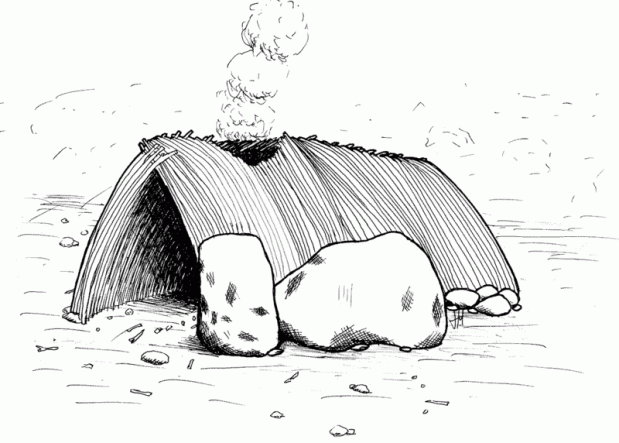
1) Koobi Fora, Okote Member y Chesowanja (Kenia): 1,5 Ma (millones de años)

En los años 80, en estos yacimientos se encontraron pequeñas áreas de tierra enrojecida asociadas a herramientas de 1,5 Ma (Okote) y 1,42 Ma (Chesowanja). Mediante técnicas de susceptibilidad magnética y luminiscencia se demostró que el coloramiento fue provocado por el fuego, pero se discute sobre si fue natural o provocado por la acción humana. El reestudio de los materiales de Okote en 2019 confirman la datación.

2) Cueva Wonderwerk (Sudáfrica): 1 Ma.

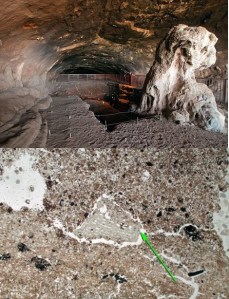
Wonderwerk

Se trata de una cueva donde se han encontrado evidencias de ocupación humana desde hace 2 millones de años hasta principios del siglo XX.

Unos restos de hogueras con cenizas y huesos (Berna et al., 2012), hallados por casualidad durante el estudio de los sedimentos donde habían aparecido unas herramientas líticas, se dataron en 1 Ma, anticipando en 200.000 años el anterior registro que se tenía de evidencias más antiguas de fuego controlado.

Estaban 30 metros adentro desde la entrada, haciendo improbable que fueran introducidos mediante causas naturales. Además se han encontrado en distintos niveles alrededor de 1 Ma. lo que sugiere que fue una zona donde se usó fuego en repetidas ocasiones. 

Sigue leyendo
The oldest human footprints by continent

The oldest human footprints by continent

AFRICA

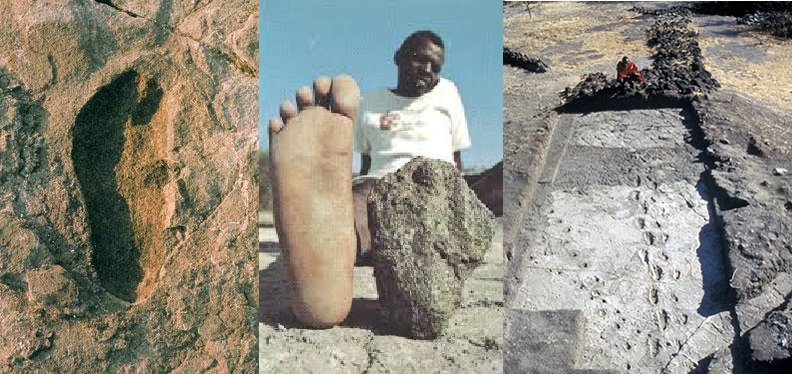
Laetoli, Tanzania. 3.66 million years (Ma).

  • Site G, found in 1978: 70 footprints made by three Australopithecus afarensis. Along with footprints were hominin and animal remains and Acheulean objects. The footprints are normally buried to protect them against the elements.
  • Site S (150 m away from Site G), found in 2015: 14 footprints made by two Australopithecus afarensis walking in the same time frame, in the same direction and at a similar moderate speed as the other three. One of them (hominin S1) had an average stature between 161-168 cm.

laetoli

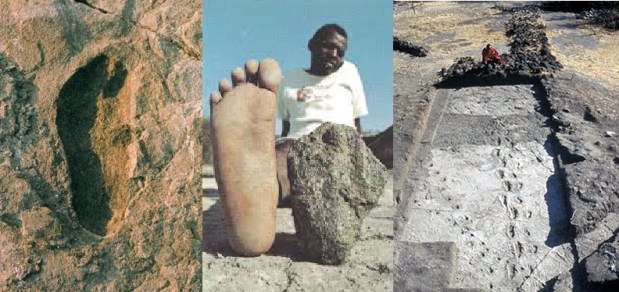
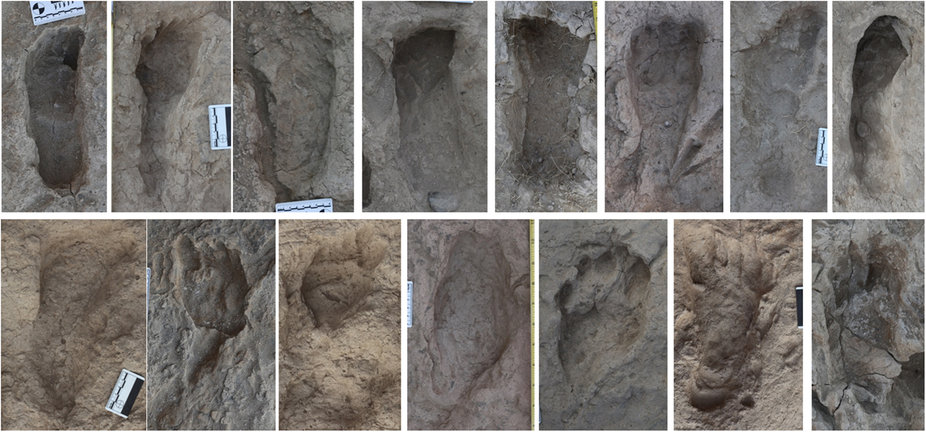
Ileret, Kenya. 1.5 Ma.  They are 97 footprints left by at least 20 Homo erectus individuals, who had a modern foot and stride: a mid-foot arch, straight big toe and heel-to-toe weight transfer. The footprints are indistinguishable from our own.

Ileret

Ileret footprints. Photo: Hatala, K. G. et al. Footprints reveal direct evidence of group behavior and locomotion in Homo erectus. Sci. Rep. 6, 28766; doi: 10.1038/srep28766 (2016)

Sigue leyendo

Human Evolution and Innovation

Paleolithic tools. Photo: Roberto Sáez

Last week I was invited to give a speech in Lisbon for an enterprise forum on Innovation, as introduction to ease the topic and break ice. First challenge was to illustrate how humans are continuously looking for innovation solutions, and always were since the origin of ‘becoming human’. Human Evolution has always been linked to Innovation. Second challenge was to make it understandable for a non-expert and multi-country audience…

Given those premises, I structured 5 key ideas:

1) The journey until reaching the capacity of innovation we currently have is amazing: we can develop projects and build things from the lowest atom level until the greatest global level – and even outside the globe. But we actually started 6 million years ago when our ancestors were ‘normal’ animals, in fact weak animals: they were eaten by predators. Eventually some of them started to use bipedalism occasionally. But yet they did not have anything special that could differentiate us from any other animals. They lived among them, they shared same resources. Sigue leyendo

5 curiosidades evolutivas de nuestra cara

Algunos rasgos morfológicos del cráneo tal vez no suelen llamar tanto la atención en su trayectoria evolutiva como la forma de la bóveda craneal, la apertura nasal, los arcos superciliares o la cresta sagital. Para empezar, los humanos modernos tenemos una característica única que ningún otro hominino ha desarrollado de manera generalizada:

El mentón

H. erectus D2735, H. heidelbergensis Mauer-1, H. neanderthalensis La Ferrassie-1, H. sapiens moderno

Existen distintas hipótesis que tratan de explicar por qué Homo sapiens desarrolló un mentón si bien, como suele pasar en paleontología, probablemente el proceso evolutivo haya seguido un recorrido multifactorial:

Sigue leyendo

The extinction of Neandertals

La Ferrassie-1 Neandertal. Photo: Roberto Sáez

The extinction of Neandertals is a huge challenge for paleoanthropologists. Neandertals and modern humans are believed to have evolved from a common ancestor about 500,000 years ago. Some researchers usually thought of Homo heidelbergensis as this common ancestor, but other hypothesis suggests that Homo heidelbergensis existed as an species only in an European niche, whilst there is a new parent species yet to be found. In any case, the ancestor evolved into Neandertals in Europe and Homo sapiens in Africa. Neandertals lived in Eurasia 200,000 years before Homo sapiens arrived from Africa. About 60,000 years ago, succesful migrations of African modern humans came into Eurasia and then also quickly to Western Europe. It is not known when they first met Neandertals, but genetic evidence shows interbreeding between both species in different periods.

A study by Tom Higham et al set the extinction of the last Neandertals around 40,000 years ago. It is based on radiocarbon dating from 40 sites across Europe. Assuming that Homo sapiens first reached Europe about 45,000 years ago, this implies a period of Neandertals & sapiens coexistence of between 5,000 and 10,0000 years.

However, the study does not include remains from Gorham’s Cave in Gibraltar, where Neandertals apparently survived until c. 30,000 years ago.

Sigue leyendo