
In 2003, the skeleton LB1 was discovered in the Liang Bua cave on Flores island, Indonesia. Published on October 27, 2004, in Nature, it belongs to a nearly complete female individual dated to 100-60 thousand years ago (ka).
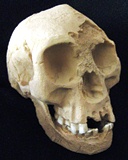
LB1 skull. Photo: Roberto Sáez
Apart from LB1, other remains were discovered in the cave. They all depict a human of reduced size (around 100 cm tall, hence the nickname «hobbit») and a small brain (around 400 cc, similar to that of adult chimps). Yet, these remains were found alongside complex tools dated to 190-50 ka and potential evidence of fire.
The discoverers (P. Brown, M. Morwood, and other coworkers) classified the fossil as a new species, Homo floresiensis. Initially dated at 18 ka, a revised stratigraphy and chronology (Sutikna et al, 2016) moved the Liang Bua finds to the range of approximately 200 ka to 60 ka.
A little background
Flores island was a lost world. Throughout the Pleistocene, access to Flores always required crossing open ocean. This extreme isolation led to the evolution of many archaic animals, which had become extinct elsewhere, into giant or dwarf forms through allopatric speciation. For example, the dwarf elephant of Flores (Stegodon). The H. floresiensis humans may have been part of this process, evolving from an ancient group of H. habilis or H. erectus (or even australopithecines) over several thousand years until approximately 15 ka.

Left: H.erectus D2700 (Dmanisi). Centre: H.floresiensis LB1. Right: H.sapiens (modern). Photo: Roberto Sáez
How do they look like?
H. floresiensis had a globular skull and low profile, with a very small brain case similar to that of australopithecines, but with a flat top-to-down shape like that of early Homo. Their faces were reduced and vertical, behind the frontal bone, with less prognathism than early Homo:
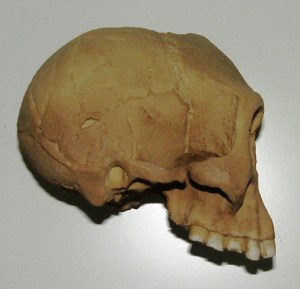
LB1 skull. Photo: Roberto Sáez
They had thick bones, a nasal cavity close to the upper dental line, prominent canine juga, rounded orbits, and double superciliary arches (though not joined like in Indonesian H. erectus), with relatively separated eyes:

LB1 skull. Photo: Roberto Sáez
Their large maxillary and teeth sizes were akin to H. erectus, perhaps even more primitive:

LB1 skull. Photo: Roberto Sáez
The lower jaw was strong, resembling H. habilis more than H. erectus, with a receding chin. Notice that there is no big difference in the dentition size vs. other Homo specimens – compared to the difference we can see in the braincases above:
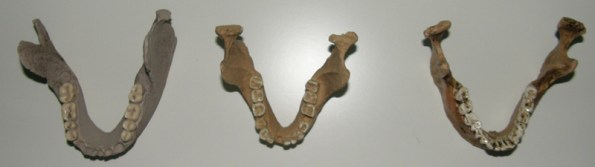
Left: H.erectus D2735 (Dmanisi). Centre: H.floresiensis LB1. Right: H.sapiens. Photo: Roberto Sáez
The upper skeleton showed robust bones and muscle insertions, long arms, and short legs, with proportions close to those of australopithecines or H. habilis. The humerus had a modern shape but was very thick like early Homo. The clavicle and shoulder morphology were primitive, close to H. erectus.
The lower skeleton also showed robust bones. Muscle insertions were oriented differently than in modern humans. The hip and pelvis morphology were smaller and wider than in modern humans. Some studies suggest they were poor runners with locomotion differing from ours, though it’s unclear if this was due to island dwarfing or pathology.
The controversy
This population presents significant challenges to the paleoanthropological community. Island dwarfing, documented in other mammals, had never been seen in humans. The Flores findings contradicted the trend of increasing brain size over human evolution.
After its publication, some discussions arose among scientists defending H. floresiensis as a separate species versus those claiming they were modern H. sapiens with pathologies, even with studies suggesting Down syndrome markers in some of the fossils.
Arguments for H. sapiens classification
- Potential signs of pathologies such as cranium-facial asymmetries and peculiar molar characteristics, such as anomalous rotations and amorphous crowns.
- Molar size decreasing sequence typical of H. sapiensand not in early Homo (though with the exception of Dmanisi specimens).
- Derived, simple, and conical canines, as expected in modern humans, distinct from early Homo (including Dmanisi).
- Some skeletal traits fall within the range of living Australomelanesian populations, such as the form of the superciliary area, nasal floor, subnasal region, orbits, and occipital superstructures.
- Skeletal growth disorders observed in modern humans. The remaining traces of muscle attachments, humeral torsion and bone thickness are either asymmetrical or unusually weak.
- Complex associated technology may have been made by other yet-undiscovered Homo populations.
Arguments for separate species evolved from primitive hominins
- A 2009 3D study of cranium morphology aligned with early Homo (1,5 Ma) similarities.
- Primitive wrist structure contrasting with modern humans. The modern wrist of H. sapiens evolved at some point between 1.8 and 0.8 Ma.
- The humerus lacks the rotation observed in H. sapiens. The shoulder blade is also angled more forwards than in H. sapiens. Both characteristics are seen in H. erectus.
- Modern people who suffer from Down syndrome typically have shorter, squatter frontol lobes than normal. But H. floresiensis has long frontal lobes.
- Morphological and statistical comparisons distinguishing H. floresiensis from modern humans with argued pathologies, like myxoedematous endemic cretinism.
- The ability to survive on a small island for thousands of years, despite pathologies, implies robust survival skills and technological prowess.
- Diverse fossil record suggesting a distinct, non-pathological dwarf population. It is highly improbable that all the members of the Flores population were diseased. Their short stature is a characteristic of the population and not a pathology.
- New finds published in 2016 reinforce the position of an ancestral group that may be on the island before 1 Ma, probably descendent from a population of H. erectus or H. habilis that migrated from the continent: 1) A lithic tool assemblage discovered on the nearby island of Sulawesi dated to 100 Ka; 2) Hominin fossils and lithic tools found in Mata Menge, Flores, dated to 700 Ka, including a partial jaw and some teeth associated with tools. The fossils suggest a small individual, even smaller than the Liang Bua people.
Conclusion
While LB1 exhibits developmental issues (dentition, asymmetries, locomotion), this doesn’t imply widespread pathology. Unfortunately, no DNA material could be recovered due to the site’s warm environmental conditions. If LB1 is not the best specimen for diagnosing the species, additional fossils may offer greater clarity. However, the controversy surrounding the ancient populations of H. floresiensis is expected to persist until more relevant finds emerge, whether from H. floresiensis fossils or other coexisting Homo populations.


Pingback: Nuevos hallazgos de homínidos en la isla de Flores – Nutcracker Man
Pingback: El puzle evolutivo humano en el sureste de Asia y Australia – Nutcracker Man
What’s up,I read your blogs named «Create a website or blog at WordPress.com» daily.Your writing style is witty, keep it up! And you can look our website about proxy free list.
Me gustaMe gusta