Another list to celebrate the end of 2019! The little tradition on this blog is to collect my favorite hominin #FossilFriday tweets of the year, from number 10 to 1. This is the fifth year of this list!
What is a ‘FossilFriday’? Every Friday, people post pics of their favorite fossils using the hashtag #FossilFriday, mainly on Twitter. This can be about famous specimens, odd fossils, museum collections, rare photos, scientific papers or blog posts. I love to join it & tweet about hominin fossils. One more time, let’s start!
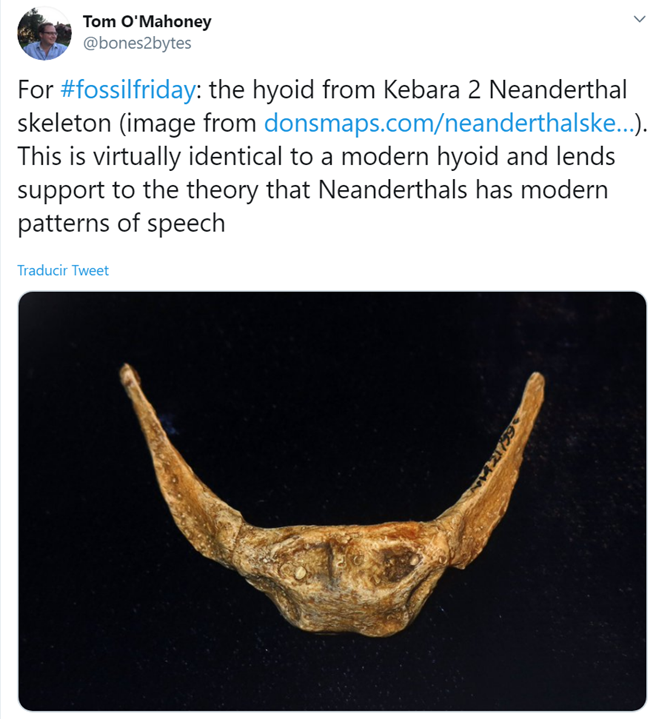
10. Feeding the debates about the dawn of ‘modern’ speech. By Tom O’Mahoney:
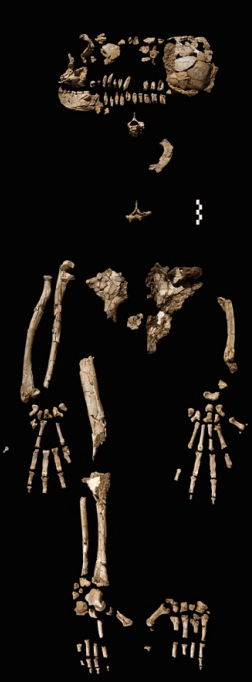
On December 17, 1992, Gen Suwa discovered the first molar of a new hominin species in Aramis, Ethiopia. Between 1992 and 1994, additional teeth and bone fragments were recovered, amounting to about 45% of a skeleton (ARA-VP-6/500) later nicknamed Ardi. White, Suwa and Asfaw defined for it the species, Ardipithecus ramidus. Interestingly, this percentage of preserved skeleton is comparable to that of Lucy (Australopithecus afarensis), discovered just 74 km north of Ardi’s site.
The ARA-VP-6/500 skeleton. Fig. 3 in White et al. (2009)In White et al. (2009) Ardipithecus ramidus and the Paleobiology of Early Hominids.
Ardi was a female, approximately 120 cm tall and weighing around 50 kg, dated to 4.4 Ma (million years). It is the most complete early hominin known to date, with key skeletal elements preserved, including parts of the skull, teeth, pelvis, hands, arms, legs, and feet. This remarkable discovery has greatly expanded our understanding of early human ancestors, particularly in terms of locomotion. The name “Ardi” means “ground floor” and “ramid” means “root” in the Afar language, suggesting that she lived on the ground and symbolized a root of the human family tree.
In just a 9 km area of the Middle Awash Valley, fossils of 35 individuals of Ar. ramidus have been discovered, along with more than 6,000 remains of diverse animal species. The region is also remarkable for other paleoanthropological sites, such as Bodo (Homo rhodesiensis, c. 600 ka—thousand years), Herto (Homo sapiens, c. 170 ka), Bouri-Hata (Australopithecus garhi, 2.5 Ma), and Daka (Homo erectus, 1 Ma).
An even older species of Ardipithecus was also found there: Ar. kadabba, dated between 5.2 and 5.8 Ma, and considered a likely ancestor of Ar. ramidus. Evidence is fragmentary, limited to a few teeth—chimpanzee-like in size, shape, and canine-premolar occlusion—and some postcranial elements that already suggest bipedal locomotion.
Ardi’s pelvis provides crucial insights. The ilium shows clear adaptations for bipedalism, while the ischium, pubis, and grasping big toe indicate strong climbing abilities but poor running efficiency. This challenges the long-standing “savanna hypothesis,” which held that bipedalism evolved in open grasslands. On the contrary, Ardi’s anatomy shows that early hominins started to develop bipedalism within forested environments around 5 million years ago. Only later, about 1 million years afterward, bipedal locomotion likely become more dominant, with climbing adaptations disappearing from hominid morphology.
Evolution of hominids and African apes since the gorilla/chimp+human (GLCA) and chimp/human (CLCA) last common ancestors. From White et al. (2009).
Most of Ardi’s remains were extremely fragile and highly fragmented—the cranium alone was found in 64 pieces. Instead of a physical reconstruction, researchers used digital microtomography, compiling more than 5,000 images to virtually reconstruct her skull.
Reconstruction of Ardipithecus ramidus skull. Credit: Roberto Sáez




 Nutcracker Man