
 The symposium »The African Human Fossil Record» in 2014 took place on 26-27 of September at Toulouse, France. This post summarizes a selection of topics presented in this meeting, in alphabetical order per author. By the way… look at the event logo on the right, really nice!
Beaudet A. et al
Some on-going studies try to determine the chronology of key sites in the Crandle of Humankind:
- Swartkrans (first place where the co-ocurrence of early Homo and Paranthropus was recognized).
- Kroomdraai (which yielded the type specimen of Paranthropus TM 1517).
- Makapansgat (deposits of Australopithecus africanus remains dating to 3.0-2.6 MYA).
The initial results of the study show that Kromdraai dating could be closer to Makapansgat, thus older than previously thought, and that the deposits of Swartkrans are younger than 2 Ma. Sigue leyendo
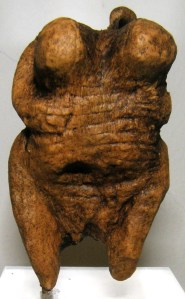 ut a mammoth-ivory figurine found in 2008 in the basal Aurignacian deposit at Hohle Fels Cave, Germany. It was made between 35-40,000 years BP. It is the oldest portable art piece found in Europe and one of the oldest artworks in general. Below are some hypotheses around the meaning of this piece (some of them are in turn applicable to most Paleolithic Venus!):
 The 4th annual meeting of the European Society for the study of Human Evolution (ESHE) took place in Florence, Italy (Sep 18th-20th). This is one of the top conferences we can see in Europe for this field.
 La cueva de Altamira (Cantabria, España) contiene un conjunto de arte rupestre que es, a la vez, el primero que se descubrió (1879) y uno de los más importantes en el mundo, tanto por su antigüedad (abarcando desde 35.000 a 15.000 años) como por su calidad artística.
 Nutcracker Man