Dentro de Cueva Mayor

Continuando el anterior post, estos son los avances en la presente campaña 2015 en los yacimientos de Cueva Mayor:

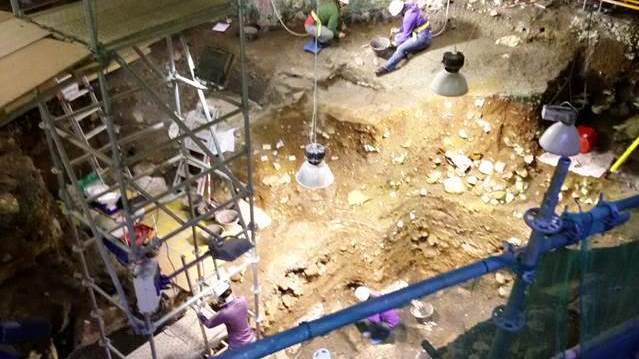
Portalón

  • Es un yacimiento localizado en la entrada de la cueva, con ocupación humana de forma continuada a lo largo del Holoceno (periodo posterior a la última glaciación, los últimos 11 Ka).
  • Los niveles del yacimiento van desde la época más reciente, Edad del Bronce (con uso habitacional y de estabulación de ganado), Calcolítico (con uso funerario), hasta la base que es Neolítico. En 2010 apareció una moneda de oro almohade del siglo XIII, testimonio de la continuidad de uso de la cueva y posible evidencia de un intercambio comercial. En 2004 se encontró un brazalete de oro de hace 3500 años en la Cueva del Silo, otra de las galerías de Cueva Mayor.
  • Ahora mismo se están excavando los niveles pre-metales (7 Ka) y se está realizando un sondeo que llega hasta final del Pleistoceno (al menos 30 Ka).
  • El foco actual es el estudio de los pobladores de la zona hace 7000 años, comenzando por el punto de vista biológico: su origen fundamentalmente puede ser Mesopotamia y el Mediterráneo Oriental, y probablemente tuvieron contacto con poblaciones provenientes del norte del Caspio y estepas de Asia Central durante el Bronce. ¿Cómo fue el contacto de los últimos cazadores-recolectores, que por entonces poblaban la zona, con las poblaciones de las estepas euroasiáticas? ¿Provocan estos la desaparición de aquellos? ¿Les desplazan? ¿Se cruzan?
  • El estudio abarca también el punto de vista del cambio tecnológico y económico que trajeron los esteparios: nuevas formas de explotación de recursos que implicaron la transformación de los ecosistemas de la sierra. Trajeron la domesticación de los caballos, mientras que la agricultura y la ganadería habían venido anteriormente, del Mediterráneo Oriental.
  • El estudio de los animales tiene un foco específico. El ADN de los restos de vacas y caballos permite por ejemplo analizar el uso de distintas razas o su uso como animales domésticos durante un tiempo y/o como alimentos.
Portalón de Cueva Mayor

Portalón de Cueva Mayor

Sima de los Huesos

  • Ahora se está excavando un sector previo a la acumulación de fósiles humanos, como estudio geológico relativo a la evolución de la cueva.

Sigue leyendo

Novedades en Atapuerca 2015, desde dentro

Las excavaciones de este año en los distintos yacimientos de Atapuerca están en plena ebullición. Transcurrida la mitad de la campaña se habían extraído 1000 sacos de sedimentos, seguro que ya muchos más a día de hoy.

¿Qué se está “cociendo” en Atapuerca este año, qué se espera de esta campaña? La semana pasada tuve la oportunidad de verlo in situ, y recojo a continuación las novedades de cada yacimiento.

Sima del Elefante

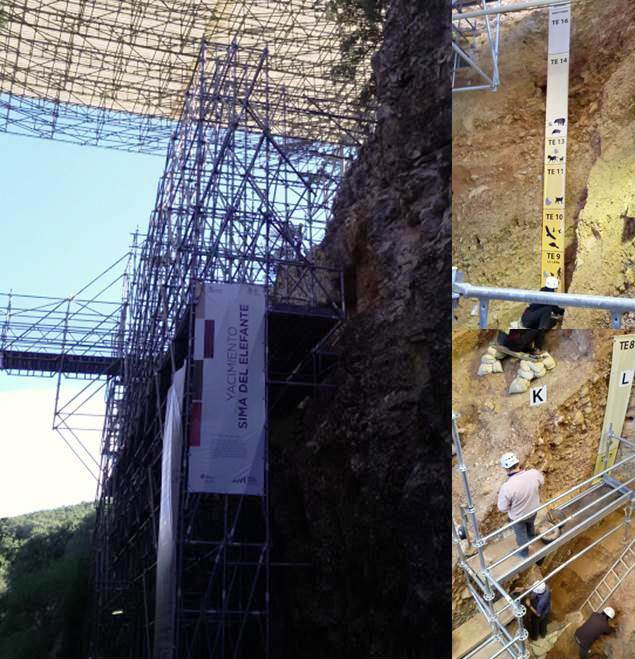
  • Se está realizando un sondeo de 4 metros por debajo del TE 9, nivel donde apareció en 2007 la mandíbula de 1,2 Ma, con características que sugieren alguna relación con Homo erectus por su morfología, pero clasificada Homo sp por ahora. También se halló por debajo de la mandíbula, hace dos años en TE 8 una lasca que indica ocupación humana.
  • Hasta ahora principalmente han aparecido restos de fauna: hipopótamos, tortugas, águila pescadora, ciervo… que indican un clima templado en aquel periodo en torno a 1,2 Ma.
  • Se ha finalizado el estudio completo del nivel 9c, a publicar próximamente. El nivel superior del yacimiento TE 19 (asociado al Pleistoceno medio, 250 Ka.) también está listo para publicar una primera interpretación de la fauna, que vivía en un clima similar al actual.
Sima del Elefante

Yacimiento Sima del Elefante

Sigue leyendo

Neandertales en Ucrania

Las evidencias más antiguas encontradas de ocupación humana en la actual Ucrania se sitúan en el yacimiento de Luka-Vrublivetska, junto al río Dnister, consistentes en algunos restos de fauna con industria achelense asociada, datados en 300 ka (miles de años).

Sin embargo, las evidencias más numerosas corresponden al periodo musteriense, con presencia de los neandertales desde hace 100 ka. La península de Crimea se ha considerado tradicionalmente uno de los últimos «refugios» de los neandertales, con dataciones de 35-40 ka, aunque en 2021 se ha revisado la antigüedad del sitio de Kabazi II a 50 ka. Este artículo describe tres importantes yacimientos neandertales en esta región.

1) Buran-Kaya

Crimea cuenta con abundante rastro neandertal. Se pudo tratar de una posible área de refugio y caza, gracias a las numerosas cuevas y terrazas fluviales de las zonas montañosas, que algunas poblaciones habitaron tal vez aislándose de la competencia de Homo sapiens.

En 1990 se encontraron herramientas de piedra en el sitio Buran-Kaya III, lo cual desencadenó el estudio del yacimiento durante dos décadas. Los principales hallazgos se resumen en los siguientes puntos: Sigue leyendo

The ‘Lomekwian’ technology?

Lately we have read much about the shocking study of 150 stone tools in Lomekwi, Kenya, close to Lake Turkana, dated to 3.3 mya: the oldest-known tools. They include flakes, cores, hammers and anvils. In fact they were found in 2011 and we already started to hear about them several weeks ago, but last week the news was widely spread. This discovery has a curious background with several controversials, which may help understand its potential importance:

  • 1) Dikika, Lower Awash (Ethiopia). In 2000 the famous Lucy’s baby specimen was found there. She was a 3-year old Australopithecus afarensis dated to 3.3 Ma. Her oficial name is ‘Selam’ which means peace. New excavations on that site in 2010 reported cut, linear marks on animal bones dated to 3.4 Ma. BUT no actual tools were found, so there were various opinions against the human action by-purpose, instead the cut marks might have been the result of trampling by humans or other animals. So, the idea of 3.4 Ma tools was more or less set aside. NOW this idea is ‘strongly’ reconsidered.
  • 2) Lomekwi (Kenya). In 1998 an interesting hominid specimen was found quite close (1 km away) to the site of the -now- famous tools. This was Kenyanthropus platyops, in theory different from Au. afarensis because of the smaller first molars, the flat lower face (however it is very distorted, so this may not be the actual morphology), and the small ear openings (similar to chimps and Au. anamensis). BUT no more relevant teeth were found (e.g. canines) nor post-cranial skeleton parts. NOW this hominid has regained much prominence because he could have been the author of the tools (same age, same location as the tools). Some argues that the stone tools may be more associated to Au. afarensis – but actually there is a parallel point to determine: if K. platyops could be just another population of australopitecines, given the enormous variation we really know about these.
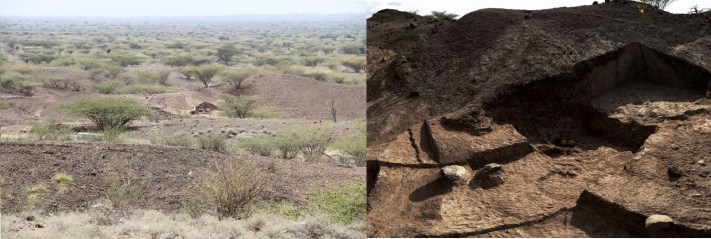
lomekwi-zoom

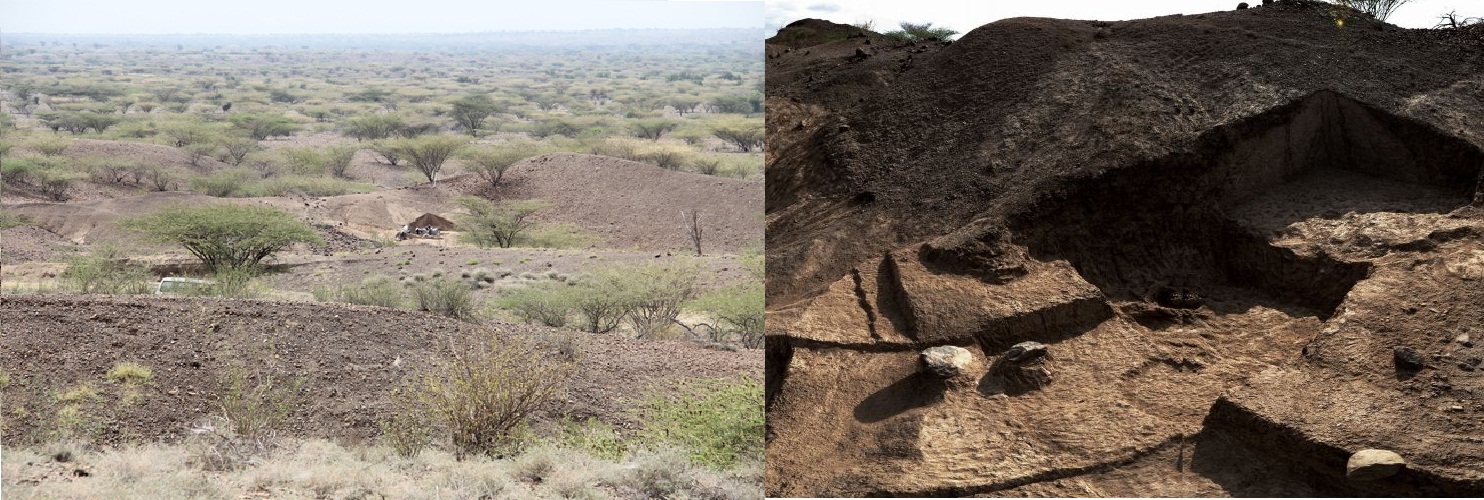
Lomekwi-3 site (I) and zoom to the excavation (R) – yes, what you see are some of the famous stones!

Focusing on the tools themselves, there is no doubt that they reflect a sophisticated understanding 3.3 million years ago of how rocks break, as well as some fine motor skills to break them effectively. Previously the oldest-known evidences of stone tools were from 2.6 mya (zebra bones with tool cuts in Gona, Ethiopia) and then different sets of tools 2.35 mya in Omo and Hadar (Ethiopia) and 2.3 mya in Lokalalei (Kenya). Finding a human technology 700,000 years older, in this ancient time range, is really amazing! What also shocks me is the proposal to define a new technology based on these findings. They researches call it ‘Lomekwian’ obviously referring to their location, in contrast to the Oldowan technology (Mode 1). The rationale is basically based on 3 points:

  1. They are larger and heavier than Olduwan.
  2. They are apparently made by hitting against a passive hammer (like chimps do today to crack nuts), rather than holding the core with the hand like in Oldowan technique.
  3. The flakes extracted show more errors or ‘accidents’ than in Oldowan technique.
flake

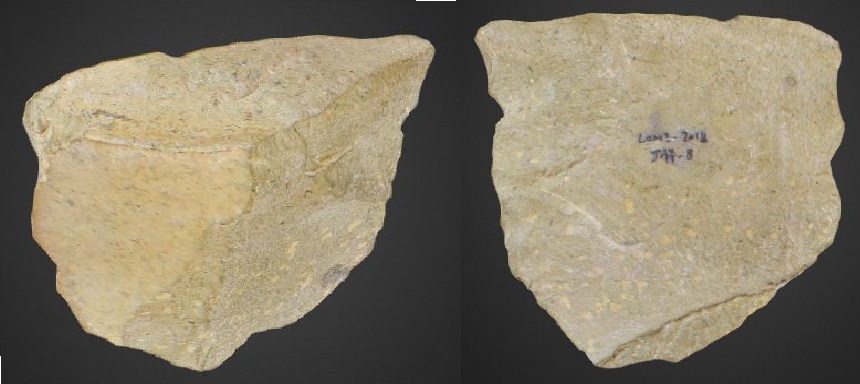
Flake LOM3 2012 J17 3 – my favorite (Photo: africanfossils.org)

In the next years we will be fortunate to live a ‘reboot’ of the paleoanthropology studies of 3 million years ago. Very quickly, we have read about the new oldest candidates for the first Homo, and now about new oldest candidates for the first technology. The old equation Homo=Technology is probably destroyed: clearly, stone tools could have been invented by multiple lineages of early hominins. We already suspect that some bone points and piercers found in South Africa (Swartkrans and Kromdraai) could have been made by robust australopithecines 2 million years ago. Chimps today use hammers and anvils to break palm nuts…

chimps

Tools used by chimps: stone anvil, hammerstone with palm nuts, ant-dipping tool and spear (Photo: humanorigins.si.edu)

… Thefore, the development of ‘technology’ is not a milestone purely linked to the appearance of Homo. Probably the learning and social skills made early hominids to explore their technical abilities and to experiment with the resources around, like stones – for millions of years! Many experiments failed, but some of them succeeded and took part in the evolution processes -for some more hundreds of thousands of years- and so hominids learnt to produce stone flakes, cores, hammers and anvils.

Were the ‘Lomekwian’ tools one of those experiments, which maybe succeeded locally? Did it become a consistent, spread technology? For the moment, I think that it seems OK to call it ‘Lomekwian’, al least for identifying precisely those key findings. By the way, this is another basic criteria to use the controversial name ‘Kenyanthropus platyops’ for the remains I described above – that is, at least for identifying precisely what this is and where this comes from.

Focus on the Sima de los Huesos

Probably in the next months we will have results about the nuclear DNA analysis of the hominid bones found in the Sima de los Huesos, dated to 430,000 years. I wanted to recap the background and importance of Sima, its findings, and what’s going on there at the present time.

Sima de los Huesos (‘Pit of Bones’) is one of the world’s most important sites of human fossils.  Located in Atapuerca, Spain, it is a sock-shaped pit with a 12 m deep vertical shaft, which turns into an inclined passage 10 meters in length, opening onto a 15 m2 chamber. So far, 7,500 hominin fossils have been found in this chamber… Sigue leyendo