La novedad con Dryopithecus y su importancia en el árbol evolutivo

Situándonos en el Mioceno, cuando los linajes de los grandes simios se fueron separando en distintas ramas evolutivas, contamos con un cierto número de fósiles encontrados en los últimos 150 años, que nos permite definir algunas de las especies ancestrales que existieron. Pero ubicar a estas especies en un árbol y dibujar las relaciones filogenéticas entre ellas es una tarea muy compleja, dado que los especímenes que las representan son aún muy escasos y fragmentarios, y dado que no existe la posibilidad de extraer información genética en fósiles tan antiguos.

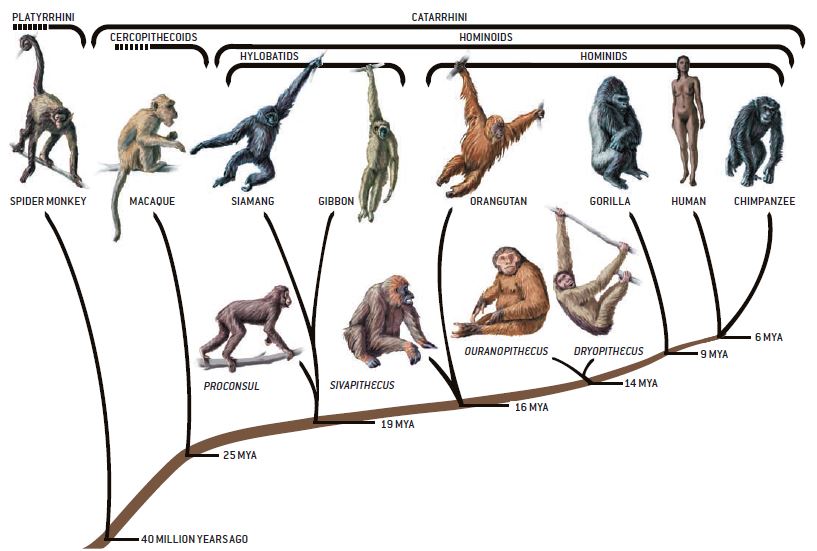
El siguiente árbol evolutivo me gusta porque es particularmente visual y permite entender rápidamente el contexto de este post.

The evolutionary history of apes. Photo: The Rockefeller University.

The evolutionary history of apes. Photo: The Rockefeller University.

Gracias a una hipótesis llamada reloj molecular planteada en 1962, podemos calcular el tiempo en que dos especies compartieron un antepasado común en función del número de diferencias genéticas entre ambas. Por ejemplo, los humanos difieren un 1,6% con los chimpancés en la secuencia del gen psi-eta-globina, con los gorilas un 1,7%, y con los orangutanes un 3,38%.

Con el reloj molecular se estima que la separación entre los linajes humano y chimpancé ocurrió hace unos 6-7 millones de años – que por cierto es el momento en que vivía la especie Sahelanthropus tchadensis, hecho que le da mucho interés… aunque esto merece otro post entero. Y la separación entre hombres y gorilas ocurriría hace unos 9 Ma.


¿Qué es Dryopithecus?

Dryopithecus es un simio fósil que nos da una información muy interesante…  Sigue leyendo

Los 13 neandertales de la cueva El Sidrón

Los 13 neandertales de la cueva El Sidrón

El Sidrón es un complejo kárstico situado en el concejo de Piloña, en el este de Asturias (España). Tiene 500 metros de largo y se formó hace entre 65-23 Ma. La red fluvial del entorno excavó cuatro niveles dentro de la cueva y varios niveles de terrazas y valles en el exterior. De hecho el arroyo principal de la depresión de El Sidrón se sume en el interior del sistema kárstico.

En 1994 cuatro espeleólogos gijoneses encontraron por azar dos mandíbulas. Dado que la cueva fue refugio durante la Guerra Civil Española, las entregaron a la Guardia Civil. Se llevó a cabo un estudio judicial y administrativo que finalizó en el año 2000 y comenzó la investigación científica.

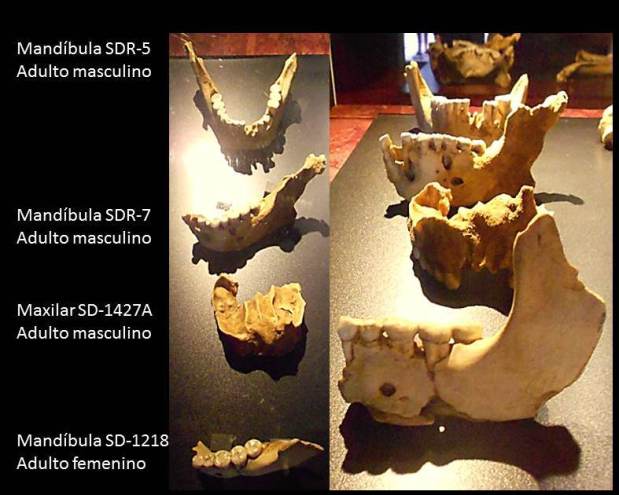
El estudio de la cueva está produciendo valiosísimos resultados. Destacan los restos de al menos 13 individuos neandertales de hace 49.000 años, que son el objeto de este post, pero también algunas variedades endémicas de murciélagos e insectos.

¿Quiénes eran los neandertales de El Sidrón? 

Sigue leyendo

Conferencia «La evolución humana, el hombre y la mujer: una historia de cooperación»

¿Qué queremos saber?

Para entender el porqué de la diferencia actual de roles entre el hombre y la mujer, es importante estudiar nuestro pasado, de dónde venimos y cómo hemos evolucionado, así como nuestro presente y el de nuestros parientes primates más próximos. Por tanto, este estudio implica de entrada buscar referencias y evidencias.

1) En cuanto a las referencias, intentamos entender y proyectar hacia el pasado la situación actual, tanto en las distintas sociedades y culturas modernas, como en las comunidades de cazadores y recolectores actuales documentadas. Y para mirar tiempos muy pasados, no tenemos más alternativa que mirar a nuestros parientes primates más próximos, los chimpancés y los gorilas.

Sin embargo, de los chimpancés nos separamos como línea evolutiva hace 6 o 7 millones de años, y de los gorilas hace más de 10. Y este tiempo tan amplio hace imposible asumir que el comportamiento actual de estos primates pueda tener algún parecido al de los ancestros que compartíamos con ellos hace millones de años. No olvidemos que todas las especies hemos evolucionado en paralelo en todo este tiempo, cada especie ha tenido su propio árbol evolutivo y, aunque nuestro comportamiento básico tiene puntos en común con nuestros parientes primates más próximos, los roles de sus machos y hembras seguramente estarán lejos de los que tuvieron nuestras especies antepasadas, los australopitecinos y los primeros Homo. De ellos, solo sabemos que tenían un gran dimorfismo sexual. Eran uno más entre los grupos de animales carroñeros, no muy numerosos, nada importantes.

2) En cuanto a las evidencias, en la prehistoria tenemos pocas en los últimos 50.000 años, y casi ninguna de más antigüedad. Recordemos que nuestra especie tiene casi 200.000 años, por lo que desconocemos un gran trozo de información. Así que solo nos quedan unas pocas evidencias, algunas referencias sociales, culturales y biológicas, y la imaginación que caracteriza a nuestra inteligencia, que es precisamente el gran factor diferencial que nos hace humanos.

Sigue leyendo

5 key facts about the nuclear DNA from Sima de los Huesos

Last week the spread of information around Homo naledi was huge. But there was another hugely important publication in the human evolution field: the results of the partial sequencing of nuclear DNA from the Sima de los Huesos site in Atapuerca, Spain. The samples were taken from two fossils, a femur and a tooth. This project is carried out by the Max Planck Institute for Evolutionary Anthropology.

The Homo naledi’s announcement was just the day before Sima’s, so the spread of the Sima news is actually happening mostly in the current week. Unfortunately I have read a few interpretations which were exagerated or inaccurate, so I wanted to summarise below a list of key facts from the Sima DNA findings:

1) The analysis is still partial. They are only some initial results. The human nuclear DNA is c. 3 billion base pairs (nucleotides) and they are reconstructing small fragments of c. 20-30 pairs each. They have been able to sequence 1 to 2 million pair bases so far (0.1%). The amount of work is huge…! The overall target is to reach an assemblage fraction of c. 0.5% to 1% of total nuclear DNA. That will be meaningful to determine the evolutionary relationships.

2) The initial results show that Sima fossils share a close affinity with Neandertals (as their morphology had already indicated), and suggests two scenarios:

  • A) They are early Neandertals or related to early Neandertals: They gave rise to the ‘classic Neandertals’. A formal classification would then be required for them – maybe even a new species.
  • B) They are in fact the earliest known Neandertals. This option is widely discarded by scientists, who are aligned more around the first option ‘A’: the partial sequence of the nuclear DNA is consistent with the Sima group being pre-Neandertals.

3) The full analysis, when finished, will not be enough to fully characterize the population form. For this, they would need a much higher fraction of at least 10%, which is almost impossible considering that this is the oldest human DNA recovered (430K years).

4) The results differ from the mtDNA analysis made in 2013, which showed a strong relation of the Sima hominids with the Denisovans, and no so much with the Neandertals. The researcher Matthias Meyer thinks this is due to some introgression of other mtDNA lineages. That suggested two scenarios:

  • Eventual interbreeding between the Denisovans and the Sima populations.
  • A common ancestor of Neandertals, Denisovans and the Sima populations.

5) If confirmed, the results will push back the H. sapiens-H. neanderthalensis ancestor beyond 400 KYA. Meyer suggested that the ancestors of H. sapiens could have diverged from the branch leading to Neandertals and denisovans 550 k to 765 k years ago. It may be possible that H. sapiens evolved in western Eurasia and later migrated back into Africa. The fossils from Europe, Asia and Africa in the 400 Ka. period are physically very diverse and may represent multiple species, only one of which could be the ancestor of today’s humans. For example, Chris Stringer thinks it may be needed to look at Homo antecessor and not Homo heidelbergensis as our last common ancestor with Neandertals.

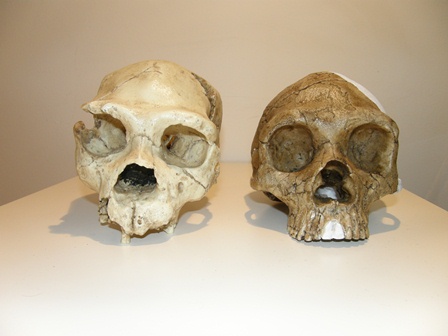
(L) Skull 5 of Sima de los Huesos. (R) Gibraltar 1 Neandertal skull from Forbes’ Quarry. Photo: Roberto Sáez

Do you want to know more about Sima de los Huesos? 

Check out this post to know everything about this amazing site! All info + slideshow here.

Quick summary about Homo naledi

A major announcement was made on Sep 10th 2015: the publication of Homo naledi, a new species of the genus Homo discovered in the Dinaledi Chamber of the Rising Star cave system, South Africa.

Naledi is an African name that originates from the Sesotho tribe in southern Africa, meaning ‘star’.

Homo naledi. Photo: Lee R. Berger

Reconstruction of Homo naledi. Credit: Lee R. Berger

About the hominid

  • 1,800 fossil specimens representing at least 15 individuals, spanning the full range of ages from infancy to old age.
  • This is the most complete assemblage of fossils from a candidate human ancestor ever found. All body parts are represented, making the Homo naledi sample richer than that of any other early human species such as Homo rudolfensis, Homo habilis, and Homo erectus.
  • Average height 1.5 m, weight 45 kg.
  • Skull: Primitive, resembling Homo habilis. Size between 466 and 560 cc, compared to H. habilis (510-700 cc), H. erectus (550-1100 cc), and H. floresiensis (426 cc).
  • Dentition: Teeth from individuals of different ages. Primitive traits include increasing size towards the back of the jaw, but they are small and simplified, set in lightly built jaws—features considered more modern.
  • Postcranial skeleton: Wrists, hands, legs, and feet are similar to those of Neanderthals and modern humans. The curved finger bones suggest climbing ability, while the legs and feet indicate long-distance walking efficiency. The overall body shows similarities to the Homo erectus fossils from Dmanisi.

About the site

  • Only hominins seem to have reached the Dinaledi Chamber. Fossil preservation is exceptional: the bones show no cut marks, no breakage, and no evidence of animal activity.
  • There is no archaeological evidence of habitation—no tools, no fire traces. The chamber was never open to the surface, and the route to it is extremely difficult. Other animals could not have accessed it.
  • The fossils were not transported by water, nor do they show signs of a catastrophic event or scavenging.
  • Conclusion: The leading hypothesis is deliberate deposition of bodies, possibly involving some form of burial or ritual, though catastrophic explanations cannot be ruled out. This scenario recalls that of the Sima de los Huesos site (Atapuerca, Spain, 430 ka). However, while the Sima hominins had brain capacities of around 1000 cc, Homo naledi was a small-brained hominin—an unexpected candidate for complex behaviors
  • Open questions: Further research must address unresolved issues: How did the hominins reach the chamber? Did the cave have another entrance in the past? How did they use fire? For now, Homo naledi is known only from the Rising Star cave system, at two locations: the Dinaledi Chamber (published in 2015) and the Lesedi Chamber (published in 2017). Was this species restricted to southern Africa?

Dating

  • Dating studies published in 2017 and 2021 place the age of H. naledi fossils between 241 and 335 ka—much more recent than early speculations, which suggested around 2 Ma, near the origin of the genus Homo.