As we approach the end of the year, it’s time for summaries. This is my little contribution! From number 10 to 1, below is the list of my favorite #FossilFriday tweets in 2014.
For those who don’t know what «FossilFriday» means… Every Friday on twitter, scientists and interested amateurs share pics of their favorite fossils, related scientific papers or blog posts, by using the hashtag #FossilFriday. This is a great manner to show famous or rare pieces of museum collections, and to share research works. I usually join this and tweet about a different hominid fossil every Friday. Now, let’s start! Sigue leyendo →
Este fin de semana he estado leyendo algunas ideas del neurocientífico Francisco Mora. Creo que provocan mucha reflexión y crítica, así que por su interés resumo aquí 5 de ellas:
La neurociencia cognitiva nos indica, a través del estudio de la actividad de las diferentes áreas del cerebro y sus funciones, que solo puede ser verdaderamente aprendido aquello que te dice algo, aquello que llama la atención y genera emoción, aquello que es diferente y sobresale de la monotonía. No hay razón sin emoción: cuando el cerebro crea los conceptos abstractos, las ideas, la información ha pasado antes por el filtro de la emoción.
La atención, ventana del conocimiento, despierta cuando hay algo nuevo en el entorno. Ese «algo nuevo» apela, como hace millones de años, a la supervivencia como último significado.
Los niños hoy aprenden, desde muy pronto, conceptos abstractos en habitaciones con ventanales sin mucha luz o luz artificial, con el rigor y la seriedad de los maestros, que se aleja de aquel “juego” primitivo que generaba aprender y memorizar de lo sensorial directo, “con alegría”, base de la atención y el despertar de la curiosidad.
La atención nace de algo que puede significar recompensa (placer) o castigo (peligro) y que por tanto tiene que ver con nuestra propia vida. Pero con el devenir evolutivo y la propia civilización, aprender y memorizar son mecanismos que los hemos llevado a unos niveles tan abstractos y de tan alto calado social que escapan y se han venido alejando de las raíces inviolables, genéticas y evolutivas, de aquella alegría que en su origen significó verdaderamente aprender y memorizar.
El cerebro de nuestra especie es igual desde hace 15.000 años. Desde entonces solo nos modela la cultura y los mecanismos de aprendizaje. Va madurando y a los 27 años ya comienza el envejecimiento; eso no ha cambiado.
Ya estaba tardando en hacer una buena visita al Museo de la Evolución Humana (MEH) en Burgos, España. La primera vez que estuve fue hace 4 años, recién inaugurado, pero brevemente y apenas pude disfrutarlo como se merece. Esta vez me propuse dedicarle una mañana entera exprimiendo el tiempo (y aun así se me hizo corta).
Entrada del MEH
Escribiré detenidamente sobre el MEH, pero si tuviera ahora que resumir y recomendar 4 cosas, serían estas: Sigue leyendo →
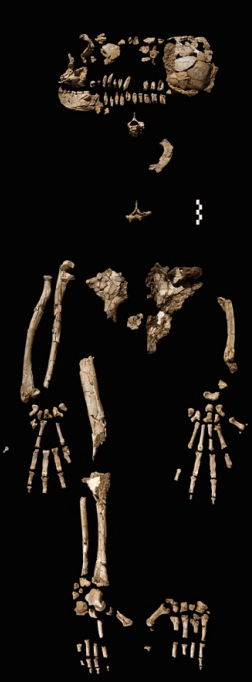
On December 17, 1992, Gen Suwa discovered the first molar of a new hominin species in Aramis, Ethiopia. Between 1992 and 1994, additional teeth and bone fragments were recovered, amounting to about 45% of a skeleton (ARA-VP-6/500) later nicknamed Ardi. White, Suwa and Asfaw defined for it the species, Ardipithecus ramidus. Interestingly, this percentage of preserved skeleton is comparable to that of Lucy (Australopithecus afarensis), discovered just 74 km north of Ardi’s site.
The ARA-VP-6/500 skeleton. Fig. 3 in White et al. (2009)In White et al. (2009) Ardipithecus ramidus and the Paleobiology of Early Hominids.
Ardi was a female, approximately 120 cm tall and weighing around 50 kg, dated to 4.4 Ma (million years). It is the most complete early hominin known to date, with key skeletal elements preserved, including parts of the skull, teeth, pelvis, hands, arms, legs, and feet. This remarkable discovery has greatly expanded our understanding of early human ancestors, particularly in terms of locomotion. The name “Ardi” means “ground floor” and “ramid” means “root” in the Afar language, suggesting that she lived on the ground and symbolized a root of the human family tree.
In just a 9 km area of the Middle Awash Valley, fossils of 35 individuals of Ar. ramidus have been discovered, along with more than 6,000 remains of diverse animal species. The region is also remarkable for other paleoanthropological sites, such as Bodo (Homo rhodesiensis, c. 600 ka—thousand years), Herto (Homo sapiens, c. 170 ka), Bouri-Hata (Australopithecus garhi, 2.5 Ma), and Daka (Homo erectus, 1 Ma).
An even older species of Ardipithecus was also found there: Ar. kadabba, dated between 5.2 and 5.8 Ma, and considered a likely ancestor of Ar. ramidus. Evidence is fragmentary, limited to a few teeth—chimpanzee-like in size, shape, and canine-premolar occlusion—and some postcranial elements that already suggest bipedal locomotion.
Ardi’s pelvis provides crucial insights. The ilium shows clear adaptations for bipedalism, while the ischium, pubis, and grasping big toe indicate strong climbing abilities but poor running efficiency. This challenges the long-standing “savanna hypothesis,” which held that bipedalism evolved in open grasslands. On the contrary, Ardi’s anatomy shows that early hominins started to develop bipedalism within forested environments around 5 million years ago. Only later, about 1 million years afterward, bipedal locomotion likely become more dominant, with climbing adaptations disappearing from hominid morphology.
Evolution of hominids and African apes since the gorilla/chimp+human (GLCA) and chimp/human (CLCA) last common ancestors. From White et al. (2009).
Most of Ardi’s remains were extremely fragile and highly fragmented—the cranium alone was found in 64 pieces. Instead of a physical reconstruction, researchers used digital microtomography, compiling more than 5,000 images to virtually reconstruct her skull.
Reconstruction of Ardipithecus ramidus skull. Credit: Roberto Sáez
Toumaï es el nombre que se da a los niños que nacen en la estación seca en el Chad. Significa «esperanza de vida» en dazaga, lengua local de Chad. Y es el apodo que también se dio al holotipo de la especie Sahelanthropus tchadensis («fósil humano del Sahel»), uno de los homínidos más importantes por varios motivos:
Vista lateral de TM 266-01-060-1, Sahelanthropus tchadensis. Crédito foto: Roberto Sáez
Tiene una antigüedad de entre 6 y 7 millones de años, el homínido más antiguo hallado, y el más cercano al antecesor común de hombres y chimpancés por el momento. Su datación tuvo que hacerse por comparación con otros fósiles de animales, al encontrarse expuesto en la superficie entre arena suelta y por tanto sujeto a posibles desplazamientos y enterramientos variables.





 Nutcracker Man