El primer Neandertal no es de Neander, y alguna anécdota más

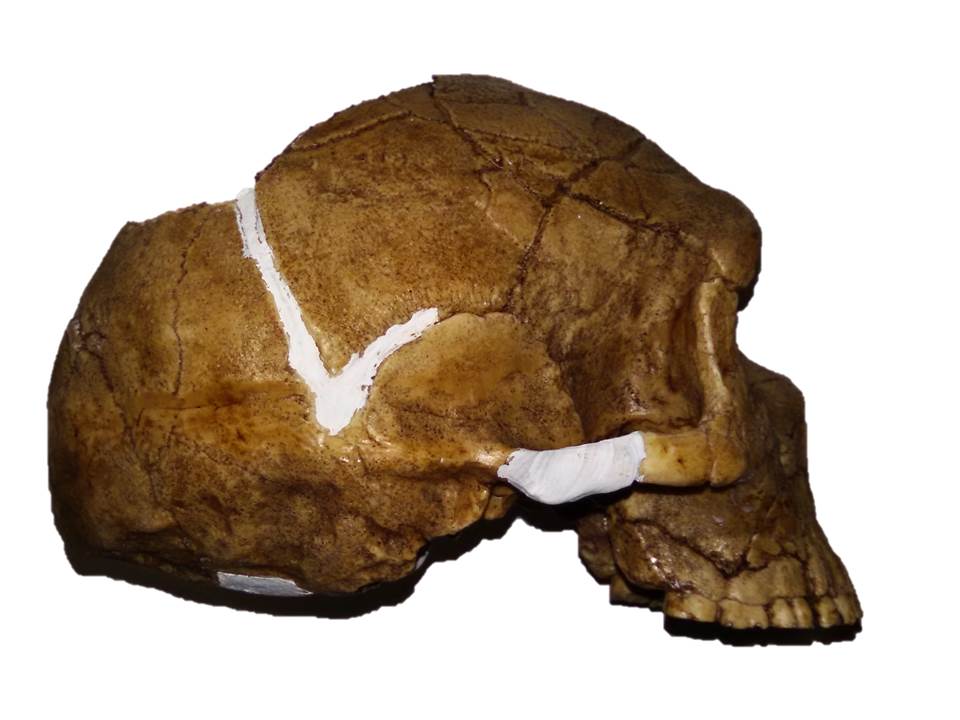
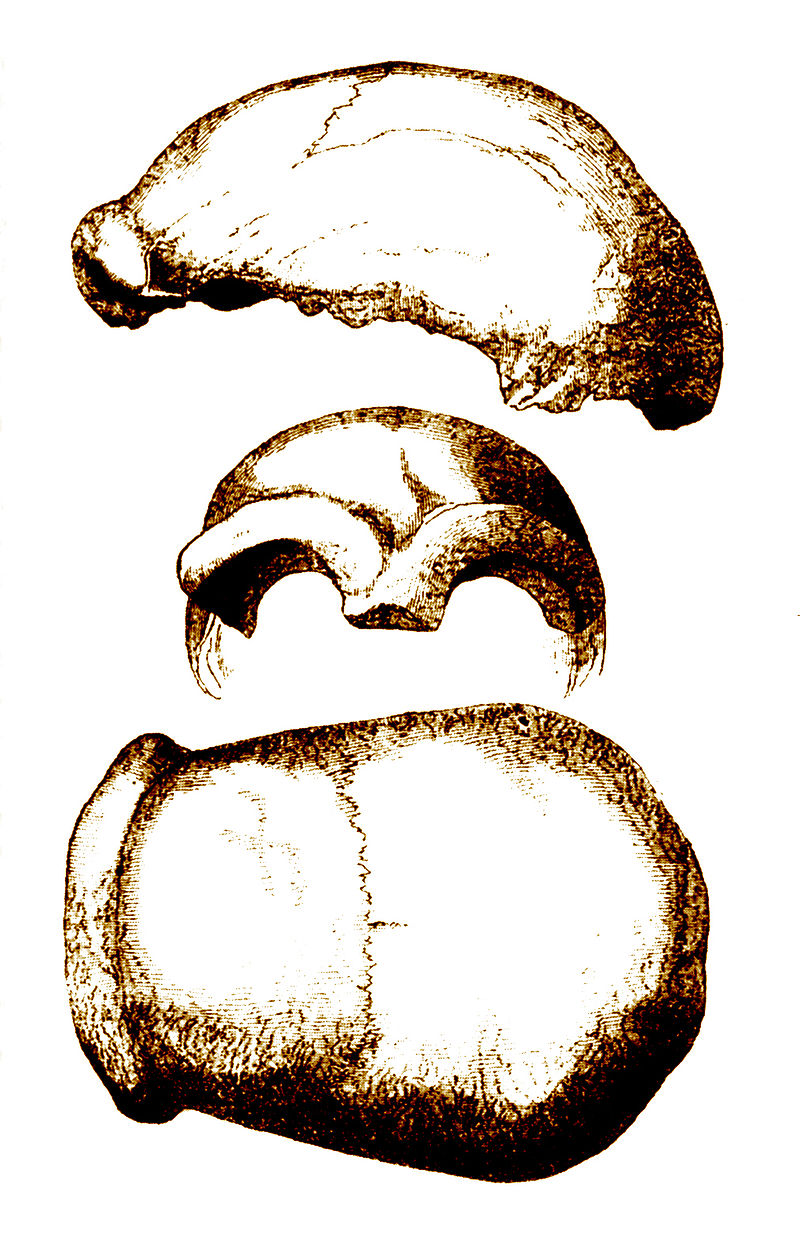
Nos situamos en 1856, tres años antes de la publicación El origen de las especies de Charles Darwin. En el valle de Neander (Alemania), por donde discurre el río Düssel, cerca de Düsseldorf, la cueva de Feldhofer se explotaba entonces como cantera. Allí los trabajadores encuentran una costilla y, a continuación, varios restos de un esqueleto humano de apariencia muy antigua: un fragmento de cráneo y una decena de huesos del esqueleto poscraneal, entre ellos un fémur. Estos restos se presentan a las comunidades científicas alemana y británica, generando un intenso debate sobre su origen y antigüedad. No fue hasta 8 años más tarde cuando el británico William King definió en 1864 para estos restos una nueva especie humana, Homo neanderthalensis.

Neanderthal-1. Imagen: Wikipedia

Pero en realidad, previamente se había encontrado en 1848 un cráneo en la cantera de Forbes (Gibraltar) al que no se dio importancia, probablemente porque era una localización muy alejada del núcleo científico de la época situado en el centro de Europa e Inglaterra. Hasta 1864 este cráneo no se volvió a estudiar y reconocer como perteneciente a la nueva especie humana que se había definido. En el mismo año 1864, pero unos meses más tarde de la denominación de Homo neanderthalensis, se propuso la de Homo calpicus basada en el primer espécimen de Gibraltar (Calpe era el nombre del peñón de Gibraltar desde época prerromana), pero no prosperó.

Cráneo Forbes’ Quarry. Foto: Roberto Sáez

Sigue leyendo

The Top 10 hominin #FossilFriday tweets of 2015

Here’s my little annual tradition!! This is the second year I do this sort of special ‘summary annual report’: the list of my favorite #FossilFriday tweets in 2015, from number 10 to 1.

For those who don’t know what “FossilFriday” means… Every Friday on twitter, scientists and interested amateurs share pics of their favorite fossils, related scientific papers or blog posts, by using the hashtag #FossilFriday. This is a great manner to show famous or rare pieces of museum collections, and to share research works. I usually join this and tweet about a different hominid fossil every Friday. Now, let’s start!   Sigue leyendo

A new Denisovan!

The Denisova Cave in Siberia’s Altai Mountains is known for being a unique place, where three different groups of humans lived in the last 100 K years: Denisovans, Neandertals and Modern Humans.

A finger phalanx (Denisova 3) and a molar (Denisova 4) from that site were published in 2010. Fortunately the genetic materials were preserved, allowing the Max Planck Institute to analyse the DNA. They resulted to be a new species, cousin of the Neandertals, named the ‘Denisovans’. Both species share a common ancestor, which in turn shares a common ancestor with Homo sapiens. Moreover, 0.5% of the genome of Denisova 3 was derived from a Neandertal population, probably related to the Neandertals that lived in the Denisova Cave.

Denisovans also interbred with some populations of Homo sapiens, contributing about 5% of the genome of some today’s Oceania people and 0.2% of the genome of Native Americans and main-land Asians.

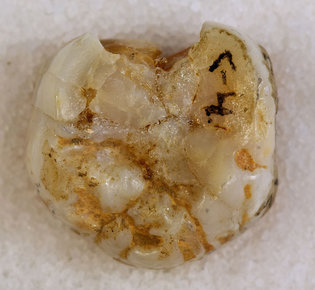
Denisova 3 was a young girl and Denisova 4 was an adult male. A second molar was found in 2010 – thought to belong to a cave bear given its size and huge, splayed roots. This was later reconsidered to be a human tooth. Its DNA was analysed by the Max Planck Institute and published in 2015. It turned out to be another adult male Denisovan specimen (Denisovan 8), the third Denisovan.

What do we know about the Denisovan DNA?

Denisova 8 molar. Photo: Bence Viola

  • Nuclear DNA sequences from the two molars form a clade with the one of the finger phalanx. The three specimens were a single biological group.
  • The mitocondrial DNA of Denisova 8 has accumulated fewer substitutions than the other two specimens. This means that he was present in the region aprox. 60 K years before the other two (c. 110 KYA). The Denisovans either occupied the region at least 110 to 50 KYA, or came into the region at least twice.
  • The nuclear DNA sequence diversity among the three Denisovans is comparable to that among the Neandertals, but lower than that among today’s humans.
  • The new genetic analysis shows less relationship to Neandertals than the analysis from 2010.
  • Although the morphology of third molars is generally variable, both molars Denisova 4 and Denisova 8 are very large and lack traits typical of Neandertals and modern humans.
  • The length of Denisova 8 is comparable to Pliocene hominins. Only two other Late Pleistocene third molars are comparable in size. The size of the two molars may suggest that large teeth is a Denisovan feature.
  • The Denisovan molars also have massively flaring roots and relatively large and complex crowns. They show similarities with the Xujiayao teeth recently described by Xing S., Martinón-Torres M. et al. Large teeth and massive roots are indicative of massive jaws. Could this be the first clue of the Denisovan morphology?

Denisova 4 molar. Photo: Bence Viola

  • As resulted from the 2010 DNA analysis, the Denisova 3 phalanx carries a component derived from an unknown hominin who diverged 1–4 MYA from the lineage leading to Neandertals, Denisovans and today’s humans. That hominin could be Homo erectus, or another ancestor we have not found any fossil yet. This new study has no clear output concerning this component, which seems to differ among the three Denisovan individuals.

Denisova 8, Denisova 4, Neandertal Krapina D109, Homo sapiens. Photo: S. Sawyer et al, PNAS

What’s next?

In March 2018 a new technique was applied to 5,639 whole-genome sequences from Eurasia and Oceania. This study concludes:

  • There was Denisovan introgression in the specimens from East and South Asia and Papuans.
  • At least two distinct instances of Denisovan admixture into modern humans occurred.
  • There is a much closer Denisovan match among Han Chinese, Chinese Dai, and Japanese DNA sequences.

Qué sabemos de Australopithecus anamensis

Desconocemos muchos datos de los representantes más antiguos del apasionante género Australopithecus: los Au. anamensis. Pero sí conocemos información de gran valor, y no solo de la morfología que muestran sus fósiles, sino también del contexto ecológico donde vivieron y algunas pistas sobre su modo de vida.

Cómo eran

Al suroeste del Lago Turkana, en el este de África, en 1965 se encontraron fósiles de 4 millones de años en la zona de Kanapoi (Kenia) pero, debido a lo remoto del lugar, no se completó su exploración hasta 1994. La mayoría eran dientes y en total pertenecen a 47 individuos. También se han asignado a este especie un conjunto de restos correspondientes a 31 especímenes en Allia Bay (al este del Lago Turkana) y, recientemente encontrados (2004), 40 dientes aislados en Woranso-Mille (en Afar, Etiopía) y un cráneo casi completo, el primero de esta especie (2016).

Estos restos constituyen lo que tenemos hasta ahora de la especie Australopithecus anamensis, y están lejos de permitirnos representar un esqueleto completo. En los restos craneales se observan claras reminiscencias primitivas de los simios del Mioceno. El espécimen tipo, KNM KP 29281, es una mandíbula relativamente pequeña con la dentición en forma de “U” estrecha, un ligero diastema entre el canino inferior y el primer premolar (P3) para albergar al canino superior, y una sínfisis mandibular muy inclinada hacia atrás, que presenta en el interior un engrosamiento robusto y alargado. El espécimen KNM KP 29283 es un maxilar con un paladar profundo y caninos con robustas raíces y coronas. Muchos de estos rasgos son primitivos. Del único cráneo (y cara) de esta especie conocido hasta la fecha, MRD, presentado en 2019, escribo en esta otra entrada.
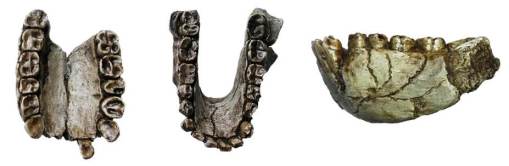
Au. anamensis KNM KP 29283 (I), KNM KP 29281 (C y D). Foto. Roberto Sáez

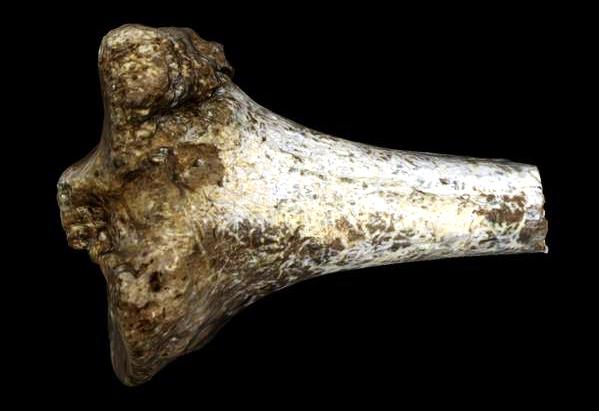
Sin embargo, los restos postcraneales muestran claramente uno de los rasgos clave que nos comenzaron a hacer humanos: la bipedación, manifestada de forma incuestionable por ejemplo en la tibia KNM KP 29285. El extremo que se articula con el fémur es ancho, por tener más tejido esponjoso para absorber las cargas de la locomoción bípeda. El extremo que se articula con el astrágalo tiene un espesamiento que también absorbe el impacto de dicha locomoción. Todos estos rasgos morfológicos los tenemos los humanos.
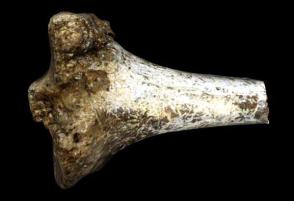
Au. anamensis KNM KP 29285. Foto: AfricanFossils.org

Su filogenia

Tradicionalmente se pensaba que Au. anamensis probablemente dio lugar a Au. afarensis por anagénesis o evolución filética, que implica la evolución progresiva de una especie hacia otra por cambios en la frecuencia genética de una población entera. Como especie antepasada, también es posible que Ardipithecus ramidus esté relacionada con Au. anamensis.

En 2019 se han revisado algunos materiales asignados con dudas a Au. afarensis pero de antigüedad similar a la de Au. anamensis, y se ha encontrado que probablemente ambas especies convivieron durante unos 100.000 años en la misma zona, lo cual pone en duda la hipótesis de la anagénesis. En todo caso, este estudio también refuerza la posible relación filogenética entre Ar. ramidus, Au. anamensis y Au. afarensis, un interesante y complejo debate que sigue abierto. Doce premolares encontrados en Woranso-Mille en 2014 son un mosaico de caracteres entre Au. anamensis y Au. afarensis, y menos primitivos que A. ramidus.

Su modo de vida

Los yacimientos con presencia de Au. anamensis tienen contextos ecológicos muy similares a los de Au. afarensis, y de hecho representan sistemas muy variados desde bosques abiertos hasta ambientes cerrados de bosques de galería.

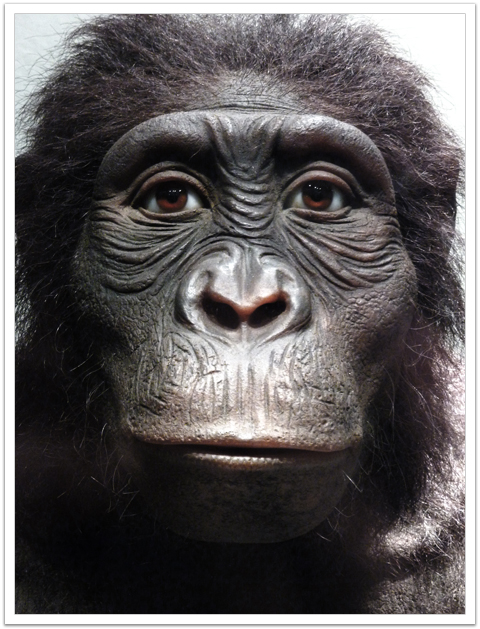
Las estrías de la dentición postcanina de algunos especímenes muestran una alimentación propia de sabanas arbustivas similar a la de primates actuales como el babuino y el mono verde. Era abrasiva y se componía de semillas, hojas, cormo y, en mucha menor medida respecto a los Au. afarensis, también frutas. Este estudio apoya el aumento de la robustez de la dentición y del aparato masticador como caracteres evolucionados respecto a los de Ardipithecus ramidus.
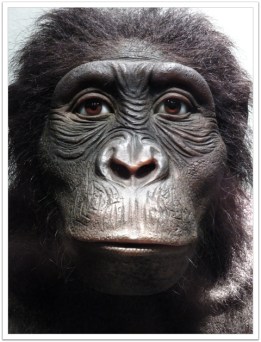
Representación de Au. anamensis. Foto: Museum für Naturkunde Berlin

Más información: El nuevo cráneo de Australopithecus anamensis: ¿encaja bien en el «árbol»? | Nutcracker Man

Quick summary about Homo naledi

A major announcement was made on Sep 10th 2015: the publication of Homo naledi, a new species of the genus Homo discovered in the Dinaledi Chamber of the Rising Star cave system, South Africa.

Naledi is an African name that originates from the Sesotho tribe in southern Africa, meaning ‘star’.

Homo naledi. Photo: Lee R. Berger

Reconstruction of Homo naledi. Credit: Lee R. Berger

About the hominid

  • 1,800 fossil specimens representing at least 15 individuals, spanning the full range of ages from infancy to old age.
  • This is the most complete assemblage of fossils from a candidate human ancestor ever found. All body parts are represented, making the Homo naledi sample richer than that of any other early human species such as Homo rudolfensis, Homo habilis, and Homo erectus.
  • Average height 1.5 m, weight 45 kg.
  • Skull: Primitive, resembling Homo habilis. Size between 466 and 560 cc, compared to H. habilis (510-700 cc), H. erectus (550-1100 cc), and H. floresiensis (426 cc).
  • Dentition: Teeth from individuals of different ages. Primitive traits include increasing size towards the back of the jaw, but they are small and simplified, set in lightly built jaws—features considered more modern.
  • Postcranial skeleton: Wrists, hands, legs, and feet are similar to those of Neanderthals and modern humans. The curved finger bones suggest climbing ability, while the legs and feet indicate long-distance walking efficiency. The overall body shows similarities to the Homo erectus fossils from Dmanisi.

About the site

  • Only hominins seem to have reached the Dinaledi Chamber. Fossil preservation is exceptional: the bones show no cut marks, no breakage, and no evidence of animal activity.
  • There is no archaeological evidence of habitation—no tools, no fire traces. The chamber was never open to the surface, and the route to it is extremely difficult. Other animals could not have accessed it.
  • The fossils were not transported by water, nor do they show signs of a catastrophic event or scavenging.
  • Conclusion: The leading hypothesis is deliberate deposition of bodies, possibly involving some form of burial or ritual, though catastrophic explanations cannot be ruled out. This scenario recalls that of the Sima de los Huesos site (Atapuerca, Spain, 430 ka). However, while the Sima hominins had brain capacities of around 1000 cc, Homo naledi was a small-brained hominin—an unexpected candidate for complex behaviors
  • Open questions: Further research must address unresolved issues: How did the hominins reach the chamber? Did the cave have another entrance in the past? How did they use fire? For now, Homo naledi is known only from the Rising Star cave system, at two locations: the Dinaledi Chamber (published in 2015) and the Lesedi Chamber (published in 2017). Was this species restricted to southern Africa?

Dating

  • Dating studies published in 2017 and 2021 place the age of H. naledi fossils between 241 and 335 ka—much more recent than early speculations, which suggested around 2 Ma, near the origin of the genus Homo.