Atapuerca 2017: 1.3 million years of continuous human presence

In the 2017 campaign, direct evidence of the presence of the ‘classic neandertal’ has finally emerged in Atapuerca. This finding completes an amazing 1.3 million-year sequence of continuous human presence in the Atapuerca complex. Join me in the following journey through time to summarise what that means…

1.1-1.3 Ma | Sima del Elefante (Homo sp)

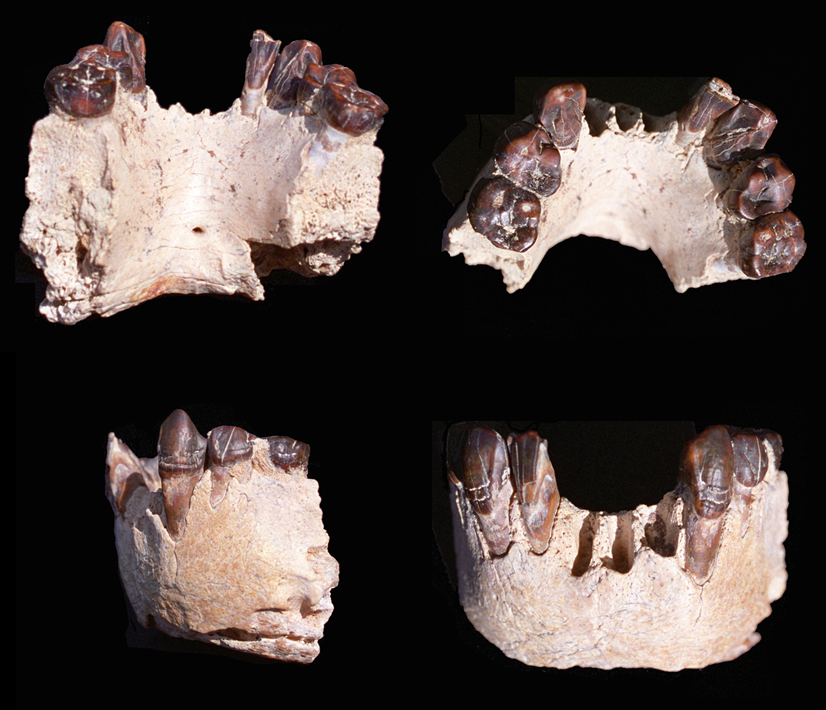
This site is a pit filled with 10 m of sediments. In 2007, a fragmentary mandible with some teeth was recovered from TE9 level, dated to 1.1-1.3 Ma. For the moment, there is no assignment to this specimen to a hominin species.

TE9d has yielded several remains of bovid, cervid, bear and many bird species, together with clear evidences of human activity at 1.3 Ma, including a flint flake. In TE16 they also found a flake estimated at 0.8 Ma.

TE7 is the oldest level in Atapuerca. In 2017 most of its surface has been cleaned producing more fauna remains. However, it may represent a period prior to the human arrival to Atapuerca. The excavation of TE7 will take place in the next 5 years.

Mandible ATE 9-1 Sima del Elefante Atapuerca

Mandible ATE 9-1 from Sima del Elefante, 2007. Photo credit: Roberto Sáez

0.8-1 Ma | Gran Dolina (Homo antecessor)

Since 1994 different samples from level TD6 (0.8 Ma) have recovered at least 15 individuals with all skeletal parts represented of Homo antecessor, potential common ancestor of neandertals and modern humans. Many bones show tool marks indicating cannibalism.

It is expected to fully reach TD6 in the next decade, where possibly hundreds of new H. antecessor fossils are waiting.

In the meantime, the 2017 campaign has progressed at the TD4 level dated to 0.9-1 Ma. They have found four new lithic tools, herbivore bones (some of them with cut marks) and carnivores like Ursus dolinensis (a species of bear defined from this site) and the European jaguar (extinct in Europe 0.5 MYA).

Gran Dolina Atapuerca

Gran Dolina. Photo credit: Roberto Sáez

Sigue leyendo

Neandertales y cromañones

Cro-Magnon

La pequeña localidad de Les Eyzies-de-Tayac-Sireuil, en el suroeste de Francia, tal vez no es muy conocida. Sin embargo, está situada en un área rocosa de gran importancia prehistórica, con varios yacimientos declarados Patrimonio de la Humanidad por la Unesco en 1979. El más conocido de ellos es el abrigo de Cro-Magnon.

Allí, en 1868 el geólogo Louis Lartet descubrió cinco esqueletos con un aspecto muy moderno. Cro-Magnon 1 se halló en asociación a conchas perforadas, huesos y dientes de fauna, útiles líticos y partículas de ocre que recubrieron el cuerpo, sugiriendo un enterramiento ritual.

El cráneo de Cro-Magnon-1 es muy redondeado y grande (cerca de 1600 cc) y tiene una cara totalmente moderna. La ausencia de dientes y la reabsorción de hueso mandibular indican una edad avanzada del individuo. Una infección fúngica le produjo hoyuelos en la cara y en el frontal. Perteneció a un individuo masculino que vivió hace entre 28.000-32.000 años.

Cromañon, Cro-Magnon 1

Cráneo Cro-Magnon 1. Muestra rasgos anatómicos típicos de los humanos modernos: forma globular, frente alta y vertical, mentón pronunciado, ancho máximo del cráneo hacia la mitad de los parietales. Destaca en este individuo la proyección de los huesos nasales, la forma particularmente alargada del cráneo, la forma bien definida y cuadrangular de las órbitas y el tamaño del proceso mastoideo. Crédito foto: Roberto Sáez

Los rasgos de Cro-Magnon contrastaban con el aspecto de los fósiles neandertales que estaban en pleno boom desde hacía pocos años, debido al hallazgo en 1856 de Neandertal-1 cerca de Dusseldorf, y la presentación de la especie Homo neanderthalensis por William King en 1864, que reunía a otros fósiles descubiertos antes que Neandertal-1 (Engis en Bélgica, Forbes’ Quarry en Gibraltar). También coincidía en el tiempo con la descripción de la industria lítica asociada a los neandertales desde 1860, fruto de los hallazgos en el abrigo de Le Moustier, situado a solo 10 km de Cro-Magnon.

Estaba naciendo un curioso binomio que trataba de contrastar “neandertales y cromañones” que perduró y, de hecho, lo recuerdo con cariño de mis primeras lecciones sobre Prehistoria en el colegio. Todavía hoy no es raro escucharlo.

Sigue leyendo

Neandertales en la Sima de las Palomas desde hace 130.000 años

La Sima de las Palomas del Cabezo Gordo está localizada en Torre Pacheco, a unos 40 km de Murcia (sureste de España). Es una cueva kárstica vertical que, por sus hallazgos desde los años 90, se ha convertido en uno de los yacimientos neandertales más importantes de Europa Occidental.

Desde 1991 se han desenterrado más de 300 huesos de al menos 11 individuos neandertales de todas las edades, incluyendo tres esqueletos notablemente completos y articulados, así como miles de objetos que ayudan a explicar la ecología de las poblaciones humanas en el área hace entre 50-130 Ka.

Los 3 esqueletos neandertales

Casi todos los restos humanos mencionados se recuperaron de una cámara pedregosa (Conglomerado A) con datación de 50 Ka, incluidos tres esqueletos muy completos:

  • Una individuo adulto femenino (SP96) y un infantil bajo el anterior (SP97), ambos con las rodillas flexionadas y los codos y manos elevadas hacia la cabeza.
  • Otro adulto (SP92) debajo del niño, con el codo extendido.
  • En asociación con los esqueletos, varios huesos de caballo quemados, 9 herramientas musterienses, 12 lascas y 100 fragmentos de desecho de talla.
  • La mujer estaba depositada sobre una capa donde se había encendido un gran fuego con anterioridad. Cerca del niño se encontraron dos patas articuladas de leopardo.
  • Numerosas piezas y lascas de piedra de gran tamaño estaban dispuestas sobre los esqueletos, tal vez a modo de protección de los cuerpos ante hienas y leopardos.
  • Puede sugerirse una colocación intencionada de los cuerpos, aunque no existen más evidencias que lo soporten.
Sima de las Palomas SP96

Sima de las Palomas. Individuo SP96 ‘Paloma’. Crédito foto: MUPANTQUAT

Conozcamos a Paloma, la neandertal más famosa

Sigue leyendo

10 homininos: miradas, gestos y paleoarte

¿Cómo eran nuestros antepasados homininos? En mi última visita al Museo de la Evolución Humana (MEH) en Burgos, España, quise detenerme en las diez fantásticas esculturas de la paleoartista Elisabeth Daynès para observar en detalle tres particularidades: las miradas, los gestos y las manos.

1. Comenzamos por Lucy, la icónica representante de Australopithecus afarensis, la primera gran aproximación a lo humano hace 3,5 millones de años. La bipedación es lo más humano que tiene Lucy (o más bien, nosotros tenemos la bipedación de ella), aunque no caminaba exactamente como nosotros. Esto se aprecia estupendamente en la escultura de Daynès, además de una mueca humana que recuerda a una sonrisa, pero que corresponde a un gesto de temor.

Australopithecus afarensis (MEH)

Australopithecus afarensis (MEH), por Elisabeth Daynès. Foto: Roberto Sáez

2. Continuamos con la Señora Ples, Australopithecus africanus, paradójicamente de aspecto más simiesco que Lucy a pesar de ser casi 1 millón de años más reciente que esta. El motivo posiblemente es que los australopitecinos del sur de África conservaban una mayor vida arbórea.

Australopithecus africanus (MEH)

Australopithecus africanus (MEH), por Elisabeth Daynès. Foto: Roberto Sáez

Sigue leyendo

Bringing hominin fossils back to life: interview with paleoartist John Bavaro

Art and science. Paleoart is the scientific reconstruction of extinct life. Complementing the study of the fossil record, paleoart has become a major contribution of deep scientific knowledge combined with the author’s artistic insight. It was a great pleasure for me to meet John Bavaro, who has great knowledge and passion in the Human Evolution field. I hope you will enjoy this interview with John for Nutcracker Man, including several examples of his very up-to-date work…

Can you describe the process to reconstruct the appearance of hominins? In particular, how do you combine the fossil evidence together with other sources to provide them movement and life?

Paleoart John Bavaro. Turkana Boy

Paleoart by John Bavaro. Figure 1. Turkana Boy

I try to apply my own understanding to the anatomy to the model before I look at other artists so then I have a fresh perspective. But my niche is in digital art which I teach at Edinboro University of Pennsylvania.

I look at Kennis Brothers, John Gurche, Elisabeth Daynès, Viktor Deak, giants in the field who do reconstructions and I’m in awe.

We are a visual species. And I for one want to explore the possibilities. Perhaps that’s what sets us apart. Art follows science and vice versa. For instance, the Lucy skeleton or the Turkana boy skeleton totally “rewrote” history. In the case of Lucy we now know that she was hybrid tree climber AND a walker. In the case of Turkana Boy there’s clues about gait and the posture etc.  It’s a puzzle that constantly revealing itself. So art follows science in the tendency for equivocation and I’m not being insulting to science when I say that. In fact, every discovery that comes out now days “rewrites” the understanding of the “mythical textbooks”.  Now with the internet we’re getting more impatient. I for one, think that’s lazy clickbait. A teaser, hubristic or both If I read something that says that “new discovery which changes the way we look at things” I say, “Yeah, until the next time which is probably at this pace, a month away.” I know that science is continuingly changing, which is counter to the current understanding (in popular culture) of it which that it is static. Those in the field know about this, but modern society holds it up as basically like religion. “Well, Science says…….” But scientists know that it is ever-changing process. In this era, changes happen at dizzying pace that I can’t keep up with them quickly enough.  It’s like same way that T-Rex was pictured just 50 or 60 years ago with the tail down instead of up.


Your work is very up to date with all recent finds in human evolution. Let’s discuss three examples: Jebel Irhoud, Homo naledi and Denisovans.

Jebel Irhoud

You have created an illustration of the human from Jebel Irhoud, dated to 300 Ka and recently proposed as the earliest Homo sapiens known so far. However this has been contested because of the primitive traits of this specimens which are different from other skulls like Omo or Herto dated to 200 Ka. To what extend did you consider the Jebel Irhoud as ‘modern’ in your illustration?

Paleoart John Bavaro. Jebel Irhoud

Paleoart by John Bavaro. Figures 2, 3, 4, 5. Jebel Irhoud

Sigue leyendo