Atapuerca: some key figures

In 2014 we had in Spain the privilege of holding the XVII Congress of UISPP (Union International de Sciences Préhistoriques et Protohistoriques) in Burgos. The organiser was the Atapuerca Foundation, as a recognition of the decisive value that Atapuerca provides to the world of Prehistory, Archaeology and Paleoanthropology.

At the time, this was the Congress with the highest number of scientific articles submitted ever in the history of UISPP: 2,000 articles presented by 3,000 authors.

Atapuerca is one of the most relevant sites for human evolution in the world, probably the most important one for the last half-million years period. Some key figures below can support this statement.

Sima de los Huesos site in Cueva Mayor:
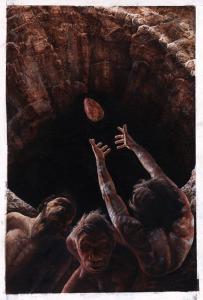
atapuerca-sima

  • A total of 7,500 fossils found so far, belonging to 29 individuals of the same population from 430,000 years ago.
  • They are ancestor of Neandertals. For one decade this population was assigned to the species Homo heidelbergensis, but the extended study of this huge fossil record discarded this assignment.
  • 17 skulls found. One of them is the most complete skull of a Middle Pleistocene Homo: Cranium number 5 (‘Miguelón’)
  • The most complete pelvis in the fossil record, called ‘Elvis’.
  • Sima also provided some tiny bones of the middle ear, really strange to find.
  • The enormous number of fossils contrast with the area they are buried in Sima. Only 20 centimeters are excavated from a 1 m2 area every season.
  • Only in 2014 200 hominin fossils have been found. This figures doubles the total number of human fossils extracted from the rest of sites worldwide.
  • Since the beginning of excavations in 1978, the Sima has provided more than half of the Homo fossils worldwide.

Gran Dolina has provided more than 100 fossils of 6 individuals from 800,000 years ago classified as a new species, Homo antecessor. They are one of the largest set of the oldest fossils in Western Europe.

Sima del Elefante has provided one of the oldest human fossils in Western Europe, dated to 1.3 million years.

Not only Paleolithic but Atapuerca also has more than 200 Neolithic sites in a 314 km2 area.

Overall, Atapuerca shows a human occupation since 1.3 million years B.P. until Roman age in the 4th century.

The extinction of Neandertals

La Ferrassie-1 Neandertal. Photo: Roberto Sáez

The extinction of Neandertals is a huge challenge for paleoanthropologists. Neandertals and modern humans are believed to have evolved from a common ancestor about 500,000 years ago. Some researchers usually thought of Homo heidelbergensis as this common ancestor, but other hypothesis suggests that Homo heidelbergensis existed as an species only in an European niche, whilst there is a new parent species yet to be found. In any case, the ancestor evolved into Neandertals in Europe and Homo sapiens in Africa. Neandertals lived in Eurasia 200,000 years before Homo sapiens arrived from Africa. About 60,000 years ago, succesful migrations of African modern humans came into Eurasia and then also quickly to Western Europe. It is not known when they first met Neandertals, but genetic evidence shows interbreeding between both species in different periods.

A study by Tom Higham et al set the extinction of the last Neandertals around 40,000 years ago. It is based on radiocarbon dating from 40 sites across Europe. Assuming that Homo sapiens first reached Europe about 45,000 years ago, this implies a period of Neandertals & sapiens coexistence of between 5,000 and 10,0000 years.

However, the study does not include remains from Gorham’s Cave in Gibraltar, where Neandertals apparently survived until c. 30,000 years ago.

Sigue leyendo

Bastones perforados: ejemplar de la cueva El Castillo

La comunidad de Cantabria, en el norte de España, es un lugar único por el número y calidad de los objetos de arte mueble encontrados. El Museo de Prehistoria y Arqueología de Cantabria expone los más emblemáticos. En particular, me quiero detener a describir una de sus joyas: el bastón perforado con un ciervo grabado de la cueva de El Castillo (Puente Viesgo, Cantabria).

Bastón perforado El Castillo

Bastón perforado Cueva El Castillo. Crédito foto: Roberto Sáez

Sigue leyendo

La cueva de Chufín

La cueva de Chufín es una de las 18 cuevas de la zona cantábrica española declaradas en 2008 Patrimonio Mundial por la UNESCO. Por ilustrar la importancia de ese status, hasta ese año solo Altamira gozaba del mismo, desde 1985.

Se encuentra en el oeste de Cantabria, próxima al límite con Asturias en el pequeño valle que forma el río Nansa, casi en realidad un desfiladero. Su acceso es muy peculiar, necesitándose caminar 15 minutos desde el pueblo más próximo (Riclones), atravesando un bosque precioso…

chufin-bosque

Sigue leyendo

Arte mueble

Un tema en el que me suelo detener dentro de la evolución humana, es el arte que ejecutaron nuestros antepasados. Dejando aparte el estudio del desarrollo de capacidades cognitivas, la mera observación de las obras que realizaban los hombres de hace 15.000 o 25.000 años y recrear su realización y uso me resulta fascinante. Por ejemplo, soy aficionado a las cuevas con arte rupestre (y privilegiado por ello al contar con muchas en España). Pero hay un aspecto artístico en particular, el arte mueble, especialmente interesante por poder ver muy de cerca esas obras con todos sus detalles, e incluso poder coleccionar algunas réplicas de ellas (que muestro más abajo).

Sigue leyendo