
Os animo a leer mi reciente colaboración en Arqueoblog, titulada «Paleoantropología: la Ciencia que está de moda» [acceso].
Neandertales en Ucrania
Las evidencias más antiguas encontradas de ocupación humana en la actual Ucrania se sitúan en el yacimiento de Luka-Vrublivetska, junto al río Dnister, consistentes en algunos restos de fauna con industria achelense asociada, datados en 300 ka (miles de años).
Sin embargo, las evidencias más numerosas corresponden al periodo musteriense, con presencia de los neandertales desde hace 100 ka. La península de Crimea se ha considerado tradicionalmente uno de los últimos «refugios» de los neandertales, con dataciones de 35-40 ka, aunque en 2021 se ha revisado la antigüedad del sitio de Kabazi II a 50 ka. Este artículo describe tres importantes yacimientos neandertales en esta región.
1) Buran-Kaya
Crimea cuenta con abundante rastro neandertal. Se pudo tratar de una posible área de refugio y caza, gracias a las numerosas cuevas y terrazas fluviales de las zonas montañosas, que algunas poblaciones habitaron tal vez aislándose de la competencia de Homo sapiens.
En 1990 se encontraron herramientas de piedra en el sitio Buran-Kaya III, lo cual desencadenó el estudio del yacimiento durante dos décadas. Los principales hallazgos se resumen en los siguientes puntos: Sigue leyendo
The key Olduvai Hominids
The following is the list of key hominids found in the Olduvai Gorge archeological sites. They are coded as OH nn (Olduvai Hominid number of fossil). The list is sorted by species and code. You can click on any pic to enlarge.
They are real treasures to understand the human origins in the last 2 million years. Don’t miss the bonus surprise at the end – Enjoy!
Homo habilis
OH 7 (1.7 Ma. Site FLK NN). It consists of 24 bones (parietal bones as most significant), teeth and mandible of a 10-12 year-old male. Discovered by the oldest son of Louis and Mary Leakey on his 20th birthday, it was thus nicknamed “Johnny’s Child”. It is the type specimen of the Homo habilis species.
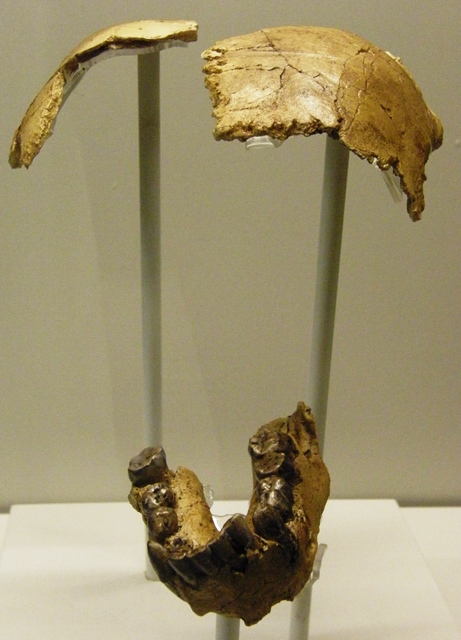
OH 7 Homo habilis. Photo: Roberto Sáez
Conferencia «La contribución de España al entendimiento de la evolución humana»
La última conferencia del ciclo sobre Evolución Humana en Boadilla quise hacerla de una forma especial. La contribución de España a esta ciencia es enorme a nivel mundial. Contamos con importantísimos yacimientos como Atapuerca y Orce, por hablar solo de los más antiguos, pero sobre todo con los grupos de científicos que los excavan y estudian, y además colaboran en la investigación de otros yacimientos (p.ej. Dmanisi, Olduvai, China…).
Y también hay un arte prehistórico asombroso que nuestros antepasados nos dejaron a lo largo de toda la geografía, y que supone la mayor concentración en Europa.
Junto a la científica, hay también una labor de difusión igualmente importante. A eso contribuyen, entre otros, el Museo de la Evolución Humana en Burgos, y el Museo de Altamira en Santillana del Mar.
El arte prehistórico fue lo que me enganchó inicialmente, luego Atapuerca. Gracias a todo ello surgió mi pasión por este mundo. De ahí lo especial de esta conferencia para mí, cuya presentación comparto a continuación.
The ‘Lomekwian’ technology?
Lately we have read much about the shocking study of 150 stone tools in Lomekwi, Kenya, close to Lake Turkana, dated to 3.3 mya: the oldest-known tools. They include flakes, cores, hammers and anvils. In fact they were found in 2011 and we already started to hear about them several weeks ago, but last week the news was widely spread. This discovery has a curious background with several controversials, which may help understand its potential importance:
- 1) Dikika, Lower Awash (Ethiopia). In 2000 the famous Lucy’s baby specimen was found there. She was a 3-year old Australopithecus afarensis dated to 3.3 Ma. Her oficial name is ‘Selam’ which means peace. New excavations on that site in 2010 reported cut, linear marks on animal bones dated to 3.4 Ma. BUT no actual tools were found, so there were various opinions against the human action by-purpose, instead the cut marks might have been the result of trampling by humans or other animals. So, the idea of 3.4 Ma tools was more or less set aside. NOW this idea is ‘strongly’ reconsidered.
- 2) Lomekwi (Kenya). In 1998 an interesting hominid specimen was found quite close (1 km away) to the site of the -now- famous tools. This was Kenyanthropus platyops, in theory different from Au. afarensis because of the smaller first molars, the flat lower face (however it is very distorted, so this may not be the actual morphology), and the small ear openings (similar to chimps and Au. anamensis). BUT no more relevant teeth were found (e.g. canines) nor post-cranial skeleton parts. NOW this hominid has regained much prominence because he could have been the author of the tools (same age, same location as the tools). Some argues that the stone tools may be more associated to Au. afarensis – but actually there is a parallel point to determine: if K. platyops could be just another population of australopitecines, given the enormous variation we really know about these.
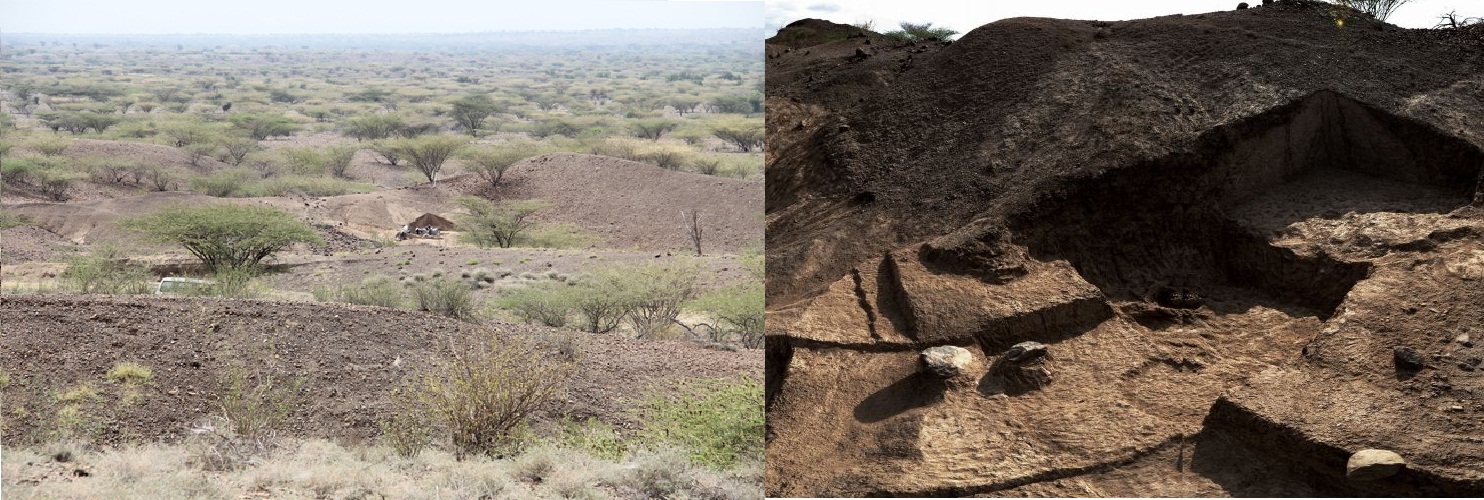
Lomekwi-3 site (I) and zoom to the excavation (R) – yes, what you see are some of the famous stones!
Focusing on the tools themselves, there is no doubt that they reflect a sophisticated understanding 3.3 million years ago of how rocks break, as well as some fine motor skills to break them effectively. Previously the oldest-known evidences of stone tools were from 2.6 mya (zebra bones with tool cuts in Gona, Ethiopia) and then different sets of tools 2.35 mya in Omo and Hadar (Ethiopia) and 2.3 mya in Lokalalei (Kenya). Finding a human technology 700,000 years older, in this ancient time range, is really amazing! What also shocks me is the proposal to define a new technology based on these findings. They researches call it ‘Lomekwian’ obviously referring to their location, in contrast to the Oldowan technology (Mode 1). The rationale is basically based on 3 points:
- They are larger and heavier than Olduwan.
- They are apparently made by hitting against a passive hammer (like chimps do today to crack nuts), rather than holding the core with the hand like in Oldowan technique.
- The flakes extracted show more errors or ‘accidents’ than in Oldowan technique.
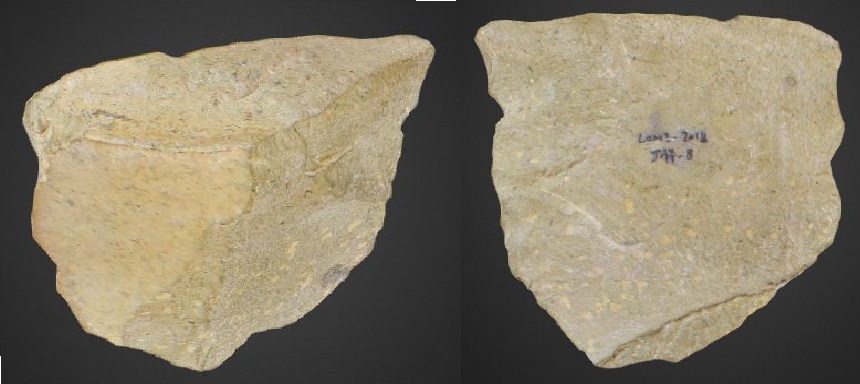
Flake LOM3 2012 J17 3 – my favorite (Photo: africanfossils.org)
In the next years we will be fortunate to live a ‘reboot’ of the paleoanthropology studies of 3 million years ago. Very quickly, we have read about the new oldest candidates for the first Homo, and now about new oldest candidates for the first technology. The old equation Homo=Technology is probably destroyed: clearly, stone tools could have been invented by multiple lineages of early hominins. We already suspect that some bone points and piercers found in South Africa (Swartkrans and Kromdraai) could have been made by robust australopithecines 2 million years ago. Chimps today use hammers and anvils to break palm nuts…

Tools used by chimps: stone anvil, hammerstone with palm nuts, ant-dipping tool and spear (Photo: humanorigins.si.edu)
… Thefore, the development of ‘technology’ is not a milestone purely linked to the appearance of Homo. Probably the learning and social skills made early hominids to explore their technical abilities and to experiment with the resources around, like stones – for millions of years! Many experiments failed, but some of them succeeded and took part in the evolution processes -for some more hundreds of thousands of years- and so hominids learnt to produce stone flakes, cores, hammers and anvils.
Were the ‘Lomekwian’ tools one of those experiments, which maybe succeeded locally? Did it become a consistent, spread technology? For the moment, I think that it seems OK to call it ‘Lomekwian’, al least for identifying precisely those key findings. By the way, this is another basic criteria to use the controversial name ‘Kenyanthropus platyops’ for the remains I described above – that is, at least for identifying precisely what this is and where this comes from.
 Nutcracker Man