Desde cuándo los hombres son diestros y por qué

Bifaz achelense. Foto: Roberto Sáez

La mayor parte de la humanidad (85%) es diestra y siempre lo ha sido. ¿Cuáles son los motivos? ¿Cómo hemos evolucionado para adoptar esta característica? La explicación puede estar basada en cinco ideas clave:

  • Nunca se ha documentado una población humana donde haya predominado el uso de la mano izquierda.
  • La lateralización de los miembros y su control desde distintos hemisferios, pudo comenzar hace 500.000 años. tal vez para realizar movimientos especializados al mismo tiempo: p.ej. el hemisferio izquierdo controlando actividades rutinarias como la búsqueda de comida, y el derecho detectando cambios en el entorno como la presencia de depredadores.
  • La especialización ayudaría al desarrollo de las capacidades cognitivas más avanzadas. De hecho, el fortalecimiento de esta asimetría pudo haber comenzado cuando los primeros homínidos adoptaron de forma habitual una postura erguida durante el uso de herramientas.
  • Sin embargo, el mayor uso de la mano derecha no se ha observado en chimpancés, ni se ha visto evidencia clara en las herramientas encontradas de entre 1-2 Ma, sino que se comienza a observar a través del desgaste dental de los homininos del Pleistoceno Medio hace 600.000 años, que sugiere una tendencia clara a que la comida se llevaba a la boca con la mano derecha.
  • Algunas hipótesis establecen que el desarrollo de la función del lenguaje en el hemisferio izquierdo evolucionó previamente al uso predominante de la diestra, siendo este un efecto de la aparición del lenguaje e intensificado por éste. Ello implicaría que ser diestros de alguna forma sería un mero efecto «accidental» en la evolución humana.
2009-History_GeographyOfHumanHandedness

Mapa sinóptico % zurdos/diestros en los últimos 10 Ma. Imagen: The history and geography of human handedness, I. C. McManus, 2009

Referencias:

  • Natalie T. Uomini (2009). The prehistory of handedness: Archaeological data and comparative ethology.  Journal of Human Evolution
  • Nicholas Toth (1985). Archaeological evidence for preferential right-handedness in the lower and middle pleistocene, and its possible implications. Journal of Human Evolution
  • W Tecumseh Fitch & Stephanie N Braccini (2013) Primate laterality and the biology and evolution of human handedness: a review and synthesis, Ann N Y Acad Sci 1288:70-85
  • Jason G. Goldman (2014). Right-handed people are dominant worldwide – but why? BBC Future
The importance of Ardi (Ardipithecus ramidus)

The importance of Ardi (Ardipithecus ramidus)

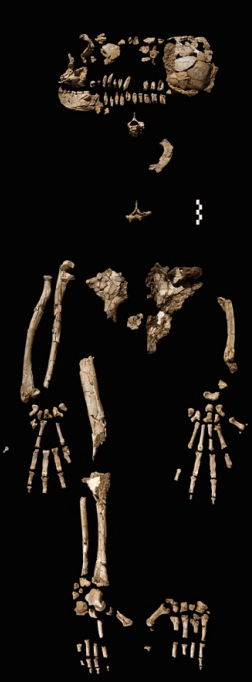
On December 17, 1992, Gen Suwa discovered the first molar of a new hominin species in Aramis, Ethiopia. Between 1992 and 1994, additional teeth and bone fragments were recovered, amounting to about 45% of a skeleton (ARA-VP-6/500) later nicknamed Ardi. White, Suwa and Asfaw defined for it the species, Ardipithecus ramidus. Interestingly, this percentage of preserved skeleton is comparable to that of Lucy (Australopithecus afarensis), discovered just 74 km north of Ardi’s site.

Ardi was a female, approximately 120 cm tall and weighing around 50 kg, dated to 4.4 Ma (million years). It is the most complete early hominin known to date, with key skeletal elements preserved, including parts of the skull, teeth, pelvis, hands, arms, legs, and feet. This remarkable discovery has greatly expanded our understanding of early human ancestors, particularly in terms of locomotion. The name “Ardi” means “ground floor” and “ramid” means “root” in the Afar language, suggesting that she lived on the ground and symbolized a root of the human family tree.

In just a 9 km area of the Middle Awash Valley, fossils of 35 individuals of Ar. ramidus have been discovered, along with more than 6,000 remains of diverse animal species. The region is also remarkable for other paleoanthropological sites, such as Bodo (Homo rhodesiensis, c. 600 ka—thousand years), Herto (Homo sapiens, c. 170 ka), Bouri-Hata (Australopithecus garhi, 2.5 Ma), and Daka (Homo erectus, 1 Ma).

An even older species of Ardipithecus was also found there: Ar. kadabba, dated between 5.2 and 5.8 Ma, and considered a likely ancestor of Ar. ramidus. Evidence is fragmentary, limited to a few teeth—chimpanzee-like in size, shape, and canine-premolar occlusion—and some postcranial elements that already suggest bipedal locomotion.

Ardi’s pelvis provides crucial insights. The ilium shows clear adaptations for bipedalism, while the ischium, pubis, and grasping big toe indicate strong climbing abilities but poor running efficiency. This challenges the long-standing “savanna hypothesis,” which held that bipedalism evolved in open grasslands. On the contrary, Ardi’s anatomy shows that early hominins started to develop bipedalism within forested environments around 5 million years ago. Only later, about 1 million years afterward, bipedal locomotion likely become more dominant, with climbing adaptations disappearing from hominid morphology.

Most of Ardi’s remains were extremely fragile and highly fragmented—the cranium alone was found in 64 pieces. Instead of a physical reconstruction, researchers used digital microtomography, compiling more than 5,000 images to virtually reconstruct her skull.

ardipithecus-ramidus
Reconstruction of Ardipithecus ramidus skull. Credit: Roberto Sáez

Toumaï, esperanza de vida

Toumaï es el nombre que se da a los niños que nacen en la estación seca en el Chad. Significa «esperanza de vida» en dazaga, lengua local de Chad. Y es el apodo que también se dio al holotipo de la especie Sahelanthropus tchadensis («fósil humano del Sahel»), uno de los homínidos más importantes por varios motivos:

Toumai, Sahelanthropus tchadensis

Vista lateral de TM 266-01-060-1, Sahelanthropus tchadensis. Crédito foto: Roberto Sáez

  • Tiene una antigüedad de entre 6 y 7 millones de años, el homínido más antiguo hallado, y el más cercano al antecesor común de hombres y chimpancés por el momento. Su datación tuvo que hacerse por comparación con otros fósiles de animales, al encontrarse expuesto en la superficie entre arena suelta y por tanto sujeto a posibles desplazamientos y enterramientos variables.

Sigue leyendo

Gigantopithecus, orangutanes y paleoproteómica

Gigantopithecus, orangutanes y paleoproteómica

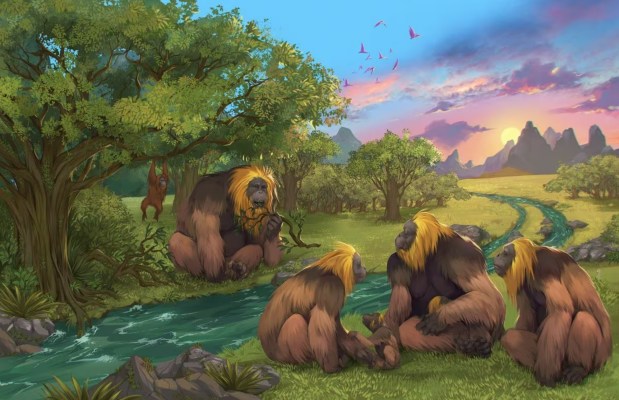
Este artículo resume nuestro conocimiento sobre el mayor primate que ha existido. El estudio de su morfología tradicionalmente relacionaba a este ser con los ponginos, cuyos únicos representantes actuales son los orangutanes (existen tres especies de ellos) y, gracias a la paleoproteómica, en 2019 se ha confirmado ese vínculo filogenético de Gigantopithecus con Pongo. Comencemos un pequeño viaje por el este asiático…

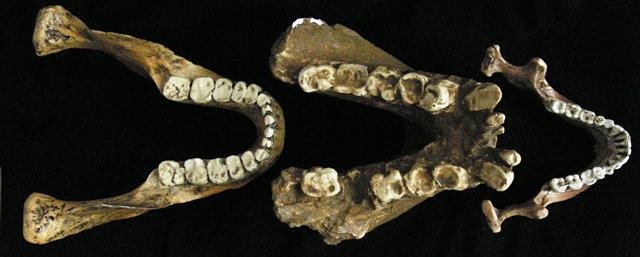
Comparación Nutcracker Man (Paranthropus boisei, izda) vs. Gigantophitecus blacki (centro) vs. Humano moderno (dcha). Foto: Roberto Sáez

Un poco de historia

  • El primer hallazgo fue en 1935, cuando el paleoantropólogo alemán Ralph von Koenigswald se topó con un molar fósil de gran tamaño en una farmacia de Hong Kong, que identificó como perteneciente a una especie primate desconocida. En los siguientes cuatro años encontró tres molares más en Hong Kong y Guangzhou. Con ellos, definió una nueva especie Gigantopithecus blacki.

Sigue leyendo

Meet the Rhodesian Man

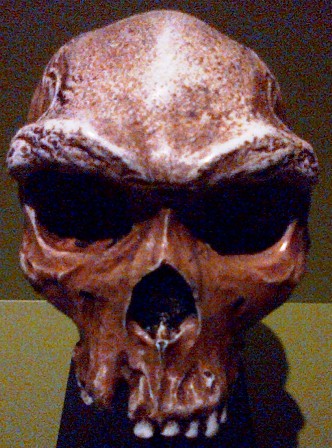
Widely known as Broken Hill 1 (also Kabwe 1), the Rhodesian Man is an almost complete cranium discovered on June 17th, 1921 in a lead and zinc mine, 18 meters below the ground level, at Broken Hill, Northern Rhodesia (now Kabwe, Zambia). It was sent in the same year to London, where it remains one of the key treasures of the Natural History Museum.

Kabwe 1 replica, NHM London. Photo: Roberto Sáez

This is a challenging specimen for the understanding of our African direct ancestors. However, the circumstances around the discovery do not help to define a precise dating to this fossil. It was found by a miner and there were no scientists around, so the initial collection of data was not the desirable: for example, the exact position and the relation to animal remains in the area. The discoverer had no clear memories of the finding. He explained that the surroundings were basically soft material, and the only few bones present were some bat bones plus a human tibia discovered one meter away on the same day. This likely corresponds to the same individual of the cranium.  Sigue leyendo