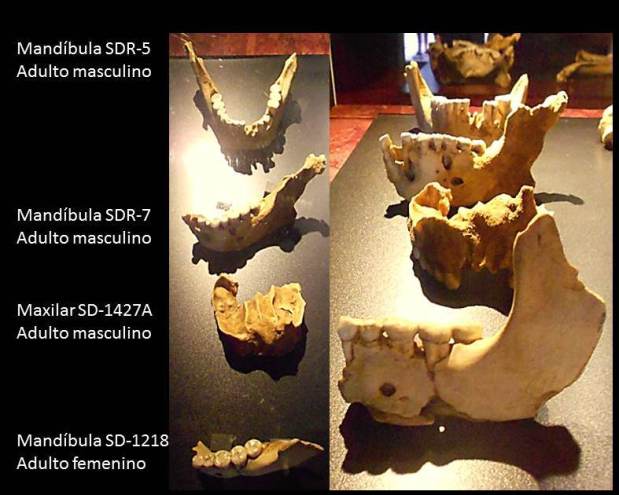
Primeras noticias del año: va de líticos

Es curioso el comienzo de 2016 en cuanto a hallazgos en Paleoantropología. Hay dos noticias que destaco por provenir, no de nuevos restos fósiles, sino de evidencias de actividad humana, en concreto de su industria lítica. Además son hallazgos en Asia, variando un poco el eje africano-europeo que suele acaparar más protagonismo:

Enero: Sulawesi (Indonesia)

El mes pasado se publicó un conjunto de 41 herramientas de piedra aparecido en la isla de Sulawesi asociadas a restos de megafauna, con una antigüedad datada en 118.000 años, y de otros 4 líticos de unos 194.000 años.

Su importancia se enmarca en el contexto de la cercanía de Sulawesi a la isla de Flores, donde se anunció en 2004 el hallazgo de Homo floresiensis. Apodado ‘hobbit’ por su tamaño enano (1 m de altura y 25 kg de peso), es una especie que probablemente evolucionó de Homo erectus hace 1 millón de años por un proceso llamado especiación alopátrica. Este proceso de evolución por aislamiento geográfico también produjo elefantes enanos y lagartos gigantes. Se piensa que aquellos Homo y otros animales pudieron llegar a Flores desde Sulawesi por navegación accidental.

Herramientas Sulawesi. Foto: Science News

Febrero: Siwalik (India) 

Sigue leyendo

The Afar Triangle

Welcome Paige Madison to Nutcracker Man! This guest post addresses a key region for the understanding of human evolution, the Afar Triangle. It is the first time this area has a focused-review on the blog, and certainly it will not be the last one…

The Afar Depression (also known as the Afar Triangle) is one of the most important areas for the study of paleoanthropology worldwide. Located in East Africa, the Afar Triangle is a part of the Great Rift Valley. The area sits on top of a junction where three continental plates meet, called a triple rift junction. At this triple rift junction, a widening rift in the Earth’s crust is currently forming. The Awash River runs through the Afar region, and near the banks of the river many important hominin fossils have been discovered.

Excavations in the Afar Triangle began in the 1970s, and discoveries continue to accrue to the present day. The hominin fossil record at Afar stretches back millions of years, representing the most continuous record of hominin habitation anywhere in the world.

Key Fossils

1.     Ardi: Ardipithecus ramidus. Discovered at a site near the Awash River called Aramis, “Ardi” was recovered from sediments dating to 4.4 million years old. The team who discovered Ardi in 1992 was led by Tim White and Gen Suwa at Berkeley. The skeleton’s name is derived from the local Afar language; “ardi” means “ground” and “ramid” means “root.” Ardi’s skeleton tells us that Ardipithecus had the ability to walk bipedally—on two legs—but probably spent a lot of time in the trees.

2.     Lucy: Australopithecus afarensis. The truly iconic skeleton of Lucy was uncovered in 1974 at the site called Hadar, close to the Awash River. Discovered by Donald Johanson of the Institute of Human Origins, Lucy dates back to 3.2 million years old. Lucy’s relative completeness tells us that some hominins were fully, habitually bipedal by 3 million years ago.
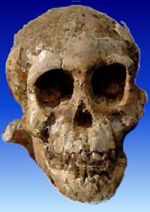
DIK-1/1, Selam. Photo: Wikipedia

3.     Selam: Dikika baby: Australopithecus afarensis. Just across the river from Hadar, the most complete skeleton of an early hominin turned up at the site of Dikika in 2003. Discovered by Zeresenay Alemseged, of the California Academy of Sciences, the Dikika individual was very young, possibly about three years old. Nicknamed Selam, this individual tells scientists that Australopithecines grew up quickly, like chimpanzees and gorillas and unlike humans (who have an extended growth period).

4.     First Family: Australopithecus afarensis: One year after Lucy was found, a team at the Institute of Human Origins discovered another amazing find, a collection of at least 17 A. afarensis individuals at a single site! The individuals are a mixture of young and old, and therefore provide information about variation within an Australopithecine population.

These discoveries are just a few of the rich hominin finds that have been uncovered in the Afar Triangle. Though these highlights have featured A. afarensis, many other taxa are represented in the area!

Afar Environment and Dating the Fossils

By examining fossils of other creatures that lived in the region—such as pigs—scientists are able to reconstruct the environment of the Afar when hominins roamed the area. Scientists use methods such as examining fossilized teeth to determine the kinds of plants local creatures ate. Scientists have learned that areas such as Hadar has not always been a dry desert, but instead was a wet, wooded environment during the time hominins were evolving.

One of the most remarkable features of the Afar region is the fact that fossils can be dated accurately and precisely. The presence of numerous volcanoes in the Afar region has resulted in some of the most accurate dates for hominin fossils anywhere in the world. The dating method used in the Afar region is called potassium argon dating, which takes advantage of the unique chemical signature of each volcanic eruption, and calibrates those eruptions on a time scale.

The Afar Today

Excavations are ongoing in the Afar Triangle through to the present day; with recent finds such as the Ledi-Geruaru jaw having been uncovered within the last few years! Continuing excavations by teams at Berkeley, the Institute of Human Origins, and other organizations, will hopefully continue to add to scientists’ knowledge about human evolution for decades to come.

About the Author

Paige Madison is a PhD candidate studying the history of paleoanthropology at Arizona State University. She blogs at fossilhistory.wordpress.com and tweets about the history of science @FossilHistory!

Los 13 neandertales de la cueva El Sidrón

Los 13 neandertales de la cueva El Sidrón

El Sidrón es un complejo kárstico situado en el concejo de Piloña, en el este de Asturias (España). Tiene 500 metros de largo y se formó hace entre 65-23 Ma. La red fluvial del entorno excavó cuatro niveles dentro de la cueva y varios niveles de terrazas y valles en el exterior. De hecho el arroyo principal de la depresión de El Sidrón se sume en el interior del sistema kárstico.

En 1994 cuatro espeleólogos gijoneses encontraron por azar dos mandíbulas. Dado que la cueva fue refugio durante la Guerra Civil Española, las entregaron a la Guardia Civil. Se llevó a cabo un estudio judicial y administrativo que finalizó en el año 2000 y comenzó la investigación científica.

El estudio de la cueva está produciendo valiosísimos resultados. Destacan los restos de al menos 13 individuos neandertales de hace 49.000 años, que son el objeto de este post, pero también algunas variedades endémicas de murciélagos e insectos.

¿Quiénes eran los neandertales de El Sidrón? 

Sigue leyendo

5 key facts about the nuclear DNA from Sima de los Huesos

Last week the spread of information around Homo naledi was huge. But there was another hugely important publication in the human evolution field: the results of the partial sequencing of nuclear DNA from the Sima de los Huesos site in Atapuerca, Spain. The samples were taken from two fossils, a femur and a tooth. This project is carried out by the Max Planck Institute for Evolutionary Anthropology.

The Homo naledi’s announcement was just the day before Sima’s, so the spread of the Sima news is actually happening mostly in the current week. Unfortunately I have read a few interpretations which were exagerated or inaccurate, so I wanted to summarise below a list of key facts from the Sima DNA findings:

1) The analysis is still partial. They are only some initial results. The human nuclear DNA is c. 3 billion base pairs (nucleotides) and they are reconstructing small fragments of c. 20-30 pairs each. They have been able to sequence 1 to 2 million pair bases so far (0.1%). The amount of work is huge…! The overall target is to reach an assemblage fraction of c. 0.5% to 1% of total nuclear DNA. That will be meaningful to determine the evolutionary relationships.

2) The initial results show that Sima fossils share a close affinity with Neandertals (as their morphology had already indicated), and suggests two scenarios:

  • A) They are early Neandertals or related to early Neandertals: They gave rise to the ‘classic Neandertals’. A formal classification would then be required for them – maybe even a new species.
  • B) They are in fact the earliest known Neandertals. This option is widely discarded by scientists, who are aligned more around the first option ‘A’: the partial sequence of the nuclear DNA is consistent with the Sima group being pre-Neandertals.

3) The full analysis, when finished, will not be enough to fully characterize the population form. For this, they would need a much higher fraction of at least 10%, which is almost impossible considering that this is the oldest human DNA recovered (430K years).

4) The results differ from the mtDNA analysis made in 2013, which showed a strong relation of the Sima hominids with the Denisovans, and no so much with the Neandertals. The researcher Matthias Meyer thinks this is due to some introgression of other mtDNA lineages. That suggested two scenarios:

  • Eventual interbreeding between the Denisovans and the Sima populations.
  • A common ancestor of Neandertals, Denisovans and the Sima populations.

5) If confirmed, the results will push back the H. sapiens-H. neanderthalensis ancestor beyond 400 KYA. Meyer suggested that the ancestors of H. sapiens could have diverged from the branch leading to Neandertals and denisovans 550 k to 765 k years ago. It may be possible that H. sapiens evolved in western Eurasia and later migrated back into Africa. The fossils from Europe, Asia and Africa in the 400 Ka. period are physically very diverse and may represent multiple species, only one of which could be the ancestor of today’s humans. For example, Chris Stringer thinks it may be needed to look at Homo antecessor and not Homo heidelbergensis as our last common ancestor with Neandertals.

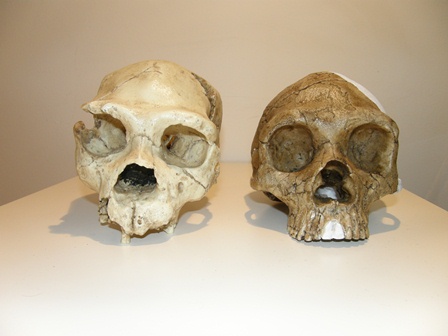
(L) Skull 5 of Sima de los Huesos. (R) Gibraltar 1 Neandertal skull from Forbes’ Quarry. Photo: Roberto Sáez

Do you want to know more about Sima de los Huesos? 

Check out this post to know everything about this amazing site! All info + slideshow here.

Novedades en Pinilla del Valle, el Valle de los Neandertales

El “Valle de los neandertales” es la denominación que se da a un conjunto de yacimientos situados en Pinilla del Valle, 90 km al norte de Madrid, y que se está convirtiendo en uno de los sitios paleontológicos más importantes del centro de la Península Ibérica. Abarca un rango temporal desde finales del Pleistoceno medio, hace 200 ka (miles de años), hasta el Pleistoceno superior hace 40 ka. He tenido la oportunidad de visitarlo y resumo aquí en qué consiste este lugar y las novedades de la campaña 2015.

El proyecto tiene tres codirectores: Juan Luis Arsuaga (Paleontología), Enrique Baquedano (Arqueología) y Alfredo Pérez González (Geología).

A finales de los años 70 comenzaron las primeras excavaciones, pero sufrieron un parón hasta que se retomaron de forma sistemática y continuada en 2002. Los trabajos se centran en el Calvero de la Higuera, con cuatro yacimientos, y varias prospecciones en otros calveros de la zona.  Sigue leyendo