Two very different specimens that coexisted: P. boisei ER 406 and H. ergaster ER 3733

Two very different specimens were found in sediments of the same age (1.7 million years) in Koobi Fora, Turkana Basin in nothern Kenya:

  • A complete but toothless cranium of Paranthropus boisei, KNM ER 406, discovered by Richard Leakey in 1968.
  • A complete cranium of Homo ergaster, KNM ER 3733, discovered by Bernard Ngeneo – in Richard Leakey’s team – in 1975.

ER 406 P. boisei and ER 3733 H. ergaster. Photo credit: Roberto Sáez

These finds were important because they were breaking the ‘simple species hypothesis’ in human evolution. According to this principle, only one species can inhabit a specific ecological niche. Those two specimens virtually coexisted, but they were really different in terms of morphology, cranial capacity and type of resources consumed:

  • The massive masticatory features and teeth associated to Paranthropus boisei are designed for a repeated activity chewing and crushing hard vegetables.
  • The Acheulean tools associated to Homo ergaster suggest a hunting or scavenving activity to get richer meat resources.
Sigue leyendo

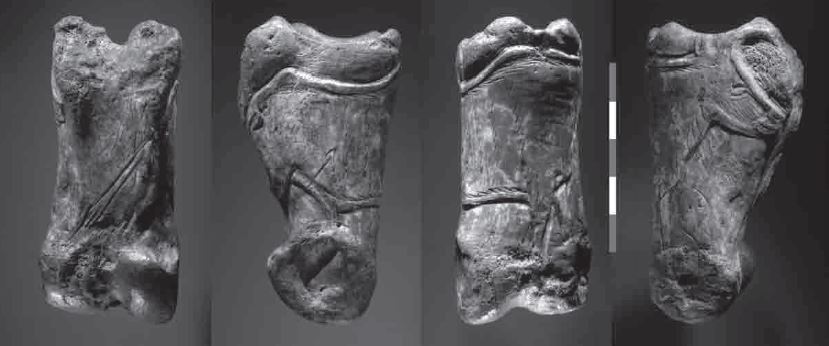
La falange grabada de la cueva de La Garma

La cueva de La Garma guarda varios de los tesoros prehistóricos de Cantabria, al norte de España. Se ha documentado arte rupestre datado en el Auriñaciense y el Gravetiense, pero además destaca un objeto muy singular de la ocupación Magdaleniense, por su rareza, calidad y complejidad técnica: una falange de uro de 83x36x44 mm que está grabada con tres figuras: un uro macho, un signo en forma de flecha (sagitaforme) y un probable antropomorfo.

Falange La Garma UPV

Falange La Garma. Foto: Veleia, EHU-UPV

Este objeto se halló en 2003, en el vestíbulo original de la cueva, donde se han recuperado también millares de herramientas líticas y restos de fauna consumida. Concretamente, la falange se encontró junto a una estructura circular de 285×254 cm que era la probable base de una cabaña. La datación de la zona corresponde a unos 14.000 años de antigüedad.

El uro grabado mide 97mm de largo y 64 mm de alto. Tiene una calidad de detalles asombrosa, de los que destaco a continuación algunos de ellos:  Sigue leyendo

How many interbreeding events between neandertals & sapiens?

100,000 years ago

An ancient population of Homo sapiens migrated 100 KYA from Africa into Asia. In the Near East they met a population of neandertals, probably around the Persian Gulf, the Arabian Peninsula or the eastern end of the Mediterranean Sea in Western Asia. Then an introgression occurred of Homo sapiens into Homo neanderthalensis.

We have found the genetic stretches of H. sapiens in the genome of a female neandertal from the Denisova Cave in the Altai Mountains, south Siberia. However there are no stretches of H. sapiens in the genome of western neandertals such as those from El Sidron, Spain.

This means that probably those hybrid neandertals+sapiens from 100 KYA migrated to East Asia. Then a climate change produced an expansion of the Caspian Sea, which probably prevented further interchange with those other neandertal populations going West towards Europe.

At the same time, that ancient Homo sapiens people who left Africa 100 KYA are thought to be in the roots of all the African modern humans populations. They are probably related with the 90 Ka populations from the Skhul and Qafzeh caves in Israel, as well as with the 47 human teeth dated to 80-120 Ka found in a limestone cave system in Daoxian, China.

60,000 years ago

Sigue leyendo

Some unusual exhibits at the Natural History Museum, London

Of course the NHM’s new Human Evolution gallery has replicas of all the iconic hominins: Nutcracker Man, Taung Child, Lucy, Turkana Boy, K. platyops, Toumai… Here I collect a list of specimens and other items that -I’m sure you will agree- are not usually found in other museums:

1) Skull 5 from Dmanisi (Georgia)

Skull 5 (D4500 cranium & D2600 mandible) is one of the most complete skulls of a Pleistocene Homo specimens. Its small brain volume (550 cc) is tiny in comparison to the other Homo erectus skulls from Dmanisi, which is another feature of the high variation in morphology of all the specimens in that site. Dated to c. 1.77 Ma.

Dmanisi

Skull 5 Dmanisi at NHM. Photo: Roberto Sáez

2) Zhoukoudian skull XI: a female Homo erectus  Sigue leyendo

Hablando del Club de Ciencia en RNE

Entrevista en RNE-1 a Roberto Sáez el 7 de febrero de 2016, sobre la creación de un club de ciencia en Boadilla del Monte, que en su primer año formó parte de la Asociación de Amigos del Palacio, antes de convertirse el 12 de junio de 2017 en la asociación de divulgación científica sin ánimo de lucro denominada Club de Ciencia Boadilla:

Ir a descargar

web: cienciaboadilla.com / email: cienciaboadilla@gmail.com