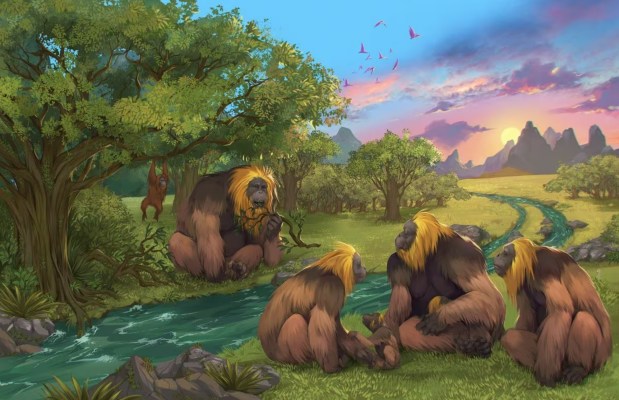
Este artículo resume nuestro conocimiento sobre el mayor primate que ha existido. El estudio de su morfología tradicionalmente relacionaba a este ser con los ponginos, cuyos únicos representantes actuales son los orangutanes (existen tres especies de ellos) y, gracias a la paleoproteómica, en 2019 se ha confirmado ese vínculo filogenético de Gigantopithecus con Pongo. Comencemos un pequeño viaje por el este asiático…
Comparación Nutcracker Man (Paranthropus boisei, izda) vs. Gigantophitecus blacki (centro) vs. Humano moderno (dcha). Foto: Roberto Sáez
Un poco de historia
El primer hallazgo fue en 1935, cuando el paleoantropólogo alemán Ralph von Koenigswald se topó con un molar fósil de gran tamaño en una farmacia de Hong Kong, que identificó como perteneciente a una especie primate desconocida. En los siguientes cuatro años encontró tres molares más en Hong Kong y Guangzhou. Con ellos, definió una nueva especie Gigantopithecus blacki.
Widely known as Broken Hill 1 (also Kabwe 1), the Rhodesian Man is an almost complete cranium discovered on June 17th, 1921 in a lead and zinc mine, 18 meters below the ground level, at Broken Hill, Northern Rhodesia (now Kabwe, Zambia). It was sent in the same year to London, where it remains one of the key treasures of the Natural History Museum.
Kabwe 1 replica, NHM London. Photo: Roberto Sáez
This is a challenging specimen for the understanding of our African direct ancestors. However, the circumstances around the discovery do not help to define a precise dating to this fossil. It was found by a miner and there were no scientists around, so the initial collection of data was not the desirable: for example, the exact position and the relation to animal remains in the area. The discoverer had no clear memories of the finding. He explained that the surroundings were basically soft material, and the only few bones present were some bat bones plus a human tibia discovered one meter away on the same day. This likely corresponds to the same individual of the cranium. Sigue leyendo →
Continuando mi post «¿Qué nos falta por saber de Lucy?«, otro punto que desconocemos sobre los fósiles de AL 288-1 es lógicamente el aspecto que tenía su rostro. Sin embargo, hemos sido capaces de reconstruir su cráneo y de hacer interpretaciones sobre cómo podría ser su cara, ya que conservamos su mandíbula inferior casi completa, unos pocos fragmentos del cráneo de Lucy y muchos más de otros 17 individuos asociados a su especie Australopithecus afarensis.
La siguiente presentación describe la morfología de su cráneo y mandíbula, y recoge una selección de 18 reconstrucciones de Lucy.
El 24 de noviembre cumple años el hallazgo de Lucy, el famoso esqueleto parcial de una hembra de Australopithecus afarensis de 3,2 millones de años (Ma) encontrado por Donald Johanson en 1974. Teniendo muchas similitudes con los simios antepasados del Mioceno, ¿qué le diferencia de ellos, a qué se debe su importancia? Entre otras cuestiones, Lucy es una de las evidencias más antiguas de bipedación incuestionada.
Por esto, hay muchísimo escrito sobre Lucy, y más que va a haber en estos días por su «cumpleaños». Sabemos mucho de ella. Sabemos incluso de qué pudo morir: las fracturas documentadas mediante tomografía computerizada de sus huesos fósiles sugieren una caída desde unos 10 metros, probablemente desde un árbol, en la que habría impactado primero con los pies y luego habría extendido los brazos, por reflejo o instinto intentando frenar su caída (Kappelman, Ketcham, Pearce et al., 2016).
Por eso, he querido centrar este artículo en lo que no sabemos de ella.
Un poco de historia
En los años 70 se hicieron muy populares los yacimientos del triángulo de Afar (Etiopía). Ahora es una zona árida y hostil, pero hace 3 Ma tenía pantanos y ríos y era rica en fauna. Allí, en la localidad de Hadar, Johanson encontró en 1973 dos fémures y una rodilla que sugerían bipedación, al año siguiente a Lucy (numerado AL-288-1), y en los siguientes años los restos de 13 individuos apodados La Primera Familia, un grupo que pudo morir por alguna catástrofe como una inundación.
En paralelo, más al sur en Laetoli (Tanzania) se encontraban otros fósiles: uno de ellos (la mandíbula LH4) es el holotipo de Au. afarensis (que significa «simio del sur de Afar»). Además en Laetoli se hallaron también las famosas huellas de tres Au. afarensis y de otros animales impresas sobre ceniza volcánica hace 3,6 Ma.
Vista parcial del esqueleto de Lucy. Foto: Roberto Sáez
The cranium of Steinheim, Germany, is probably the most strange mix of hominin characteristics in the European Middle Pleistocene.
It is assigned by many authors to Homo heidelbergensis, but this specimen actually supports the hypothesis against the definition of Homo heidelbergensis as a single umbrella of multiple fossils from a wide range of geographies: Mauer, Vértesszőllős, Bilzingsleben, Arago, Petralona, Bodo, Broken Hill, Dali and other Middle Pleistocene findings. These are not assigned to Homo erectus, but we do not have a full understanding of the migration flows that clearly could justify assigning all of them to just one species. Some proposals consider that Neandertals and H. sapiens may have had another chronological preceding species different from H. heidelbergensis. Steinheim is sometimes described as an early Neandertal, together with other European Middle Pleistocene specimens such as the Sima de los huesos population.
The Steinheim cranium is gracile and seems to be a female of 250-350 ka. Its size is smaller and its cranial features are less robust in comparison to other European remains like Arago XXI or Petralona 1. Actually the only clear Neandertal feature is the occipital bun, while many other features anticipates Homo sapiens: for example the presence of canine fossa, and the face which is longer, smaller and flatter than the Neandertal face.
Steinheim cranium. Photo: Roberto Sáez
Steinheim cranium. Photo: Roberto Sáez
It retains some primitive characters though, intermediate between Homo erectus and H. sapiens, such as the heavy browridges and the small cranial capacity of 1100 cc, similar to Cranium 5 from the Sima de los Huesos in Atapuerca. The quite spherical braincase is similar in shape to that of Homo sapiens.




 Nutcracker Man