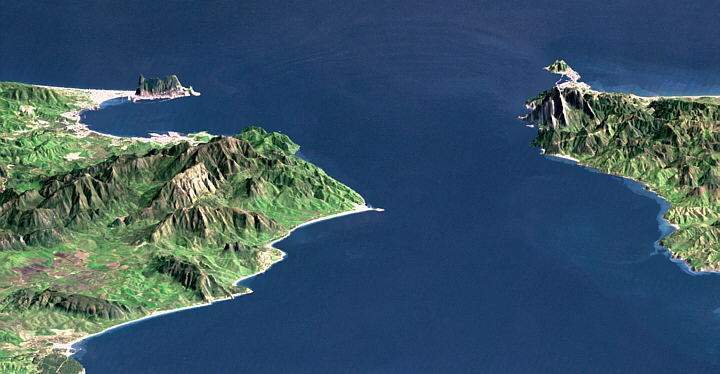
¿Cruzamos o no cruzamos Gibraltar hace 1 millón de años?

Cueva Victoria (Murcia), en el sureste de España, es un importante yacimiento paleontológico del Pleistoceno Inferior e inicios del Pleistoceno Medio, con hallazgos de más de 90 especies de vertebrados. Hace 1 Ma. esta localización tenía un clima muy parecido a la costa norteafricana, que se halla 200 km al sur. El estudio de la cronología de Cueva Victoria [1] indica la presencia de fósiles del babuino gigante africano Theropithecus oswaldi leakeyi en niveles de 0,9 Ma. (MIS 22). Son los únicos restos de Theropithecus en Europa.

Por otra parte, en 2009 se documentó en Cueva Negra del Río Quípar (100 km al noroeste de Cueva Victoria) la evidencia más antigua de líticos achelenses en Europa, con una datación también correspondiente al MIS 22 [2, 3]. Esta industria es semejante a la encontrada en el norte de África y, a su vez, es ausente en el este de Europa.

Estos dos estudios sugieren la teoría de una dispersión de homininos (y de Theropithecus) a través del Estrecho de Gibraltar hace al menos 0,9 Ma., cuando el nivel del mar estaba 100-120 m por debajo del actual, y el estrecho tendría una anchura de unos 5-7 km (frente a los 14 km actuales). En estas circunstancias, en algunas zonas del estrecho existirían numerosos islotes que podrían haber ayudado a cruzar desde África a la Península Ibérica a través de brazos de mar, bien a nado o bien con la ayuda de algún tipo de navegación primaria.


Dudas

  • Desconocemos aspectos de la paleogeografía del estrecho de Gibraltar en el Pleistoceno inferior: ¿se pudieron producir cambios importantes como un brazo más continuado de tierras emergidas?

Estrecho de Gibraltar. Foto: EcuRed

Sigue leyendo

A few quick reflections by John Hawks

Reading John Hawks’ reflections on social media is usually a pleasure. I wanted to collect here just 20 of my favorite ones. Enjoy!   —   Thanks, Professor

Serious

  • 1- When I think of the students who are entering paleoanthropology, they are going to be my scientific peers five, ten years from now. Why in the world would I not want them to have the best, most current data from our fieldwork? I’m struggling to understand the mindset of scientists who think that students shouldn’t see the fossils.
  • 2- Four years ago we did an event at the AAPA meetings where we brought casts of fossils for the membership. What stunned me is that these practicing and teaching biological anthropologists were not only crowding around the new discoveries. They were also straining to see famous fossils that have been out of the ground for 40 years, that they’ve never been able to examine because casts cannot be bought. We must change this culture.
  • 3- Tired of seeing question «Which hominin was the stone tool maker?» In absence of further evidence, the correct answer is «Any and all».
  • 4- Paleoanthropologists have an unfortunate tendency to smuggle in assumptions and then act as if the resulting conclusions were real.
  • 5- I’m a scientist. I don’t want to people to accept that what I say is accurate. I want to give them the tools to find out for themselves.

Sigue leyendo

Las tres poblaciones antepasadas de los europeos actuales

Se ha publicado el estudio genético más completo sobre una población de euroasiáticos occidentales, correspondiente a un rango temporal desde hace 2300 años y 8500 años. La antigüedad mayor del rango corresponde al momento previo a la revolución del modelo económico y social que llamamos Neolítico.

La muestra ha sido sobre 230 individuos, de entre ellos 163 nuevos, e incluyendo por primera vez genoma de agricultores neolíticos de Anatolia (Turquía), de los que provienen los primeros agricultores europeos.

Resumo en cuatro ideas lo que sabemos hasta ahora:

1) Se confirma el hallazgo de una tercera contribución genética de los antepasados de los europeos modernos, tal como se había previsto en otra publicación anterior de 2014 sobre el genoma de 9 individuos. De esta forma, la población actual europea proviene de una mezcla genética de 3 poblaciones a lo largo de los últimos 8000 añosSigue leyendo

The first Europeans: evidences in Southern Spain

We have no evidence of human presence in Europe before 1.5 million years ago. The study of the European colonization is particularly exciting in the human evolution field.

1.5 MYA the populations of Homo erectus (Homo ergaster) were growing and expanding in Africa. They were giving rise to a new species which was the first humans migrating outside Africa into Europe via the Levant Corridor and went over the Danube-Rhine valleys. Subsequent migrations did the same path in search of areas with better climate and resources.

At this moment of the Middle Pleistocene, the first human populations in Europe were a dispersed grid throughout a vast area. They were a genetic mosaic. Some of them evolved independently in response to local adaptations to environmental changes. Some of them interbred with other populations as they were incoming in further migrations.

The first Europeans

The first Europeans. Image: Roberto Sáez

Sigue leyendo

Qué hay de nuevo con nuestro ADN neandertal

Sabemos desde 2010 que todas las poblaciones humanas fuera de África presentamos en nuestro ADN un pequeño rastro de genoma neandertal (entre el 1 y 3%), y desde 2020 que también las poblaciones sub-saharianas tienen aproximadamente un 0,3%, traído por humanos modernos que volvieron a África. Por ejemplo, el estudio del genoma de un hombre de la cueva Mota en Etiopía de hace 4500 años (presentado en octubre de 2015 y corregido en enero 2016), muestra que no presenta rastro neandertal e indica que, posteriormente a este individuo, ocurrió una migración inversa desde Eurasia hace unos 3000 años al Este de África, que trajo una exigua presencia neandertal en el ADN de poblaciones de esa región, entre el 0,3-0,5%.

¿Cuándo se cruzaron? 

Sigue leyendo