Denisovans, Neandertals and Human emotions

In 2015 the genome of Oase-1 was published, a Homo sapiens individual from Romania who lived 38-42 thousand years ago (ka). The study of the genetic material preserved in the mandible showed that this individual had a Neandertal ancestor as recently as four to six generations back. That was shocking…

Now we also have the genome from a long bone of a female human (Denisova 11, aka ‘Denny’) found at the Denisova Cave in Siberia, who was at least 13 years old at death according to its cortical thickness. Direct dating of the fossil showed it to be beyond the radiocarbon limit, hence it is older than 50,000 years, probably around 90-100 ka. Oase-1 now pales in comparison to the findings from Denny…

  • Denny’s DNA fragments carried alleles matching in similar proportions the Denisovan genome and the Neandertal genome. She was the daughter of a Neandertal mother and a Denisovan father.
  • The Denisovan father had more than one Neandertal ancestor in his genealogy, as recently as 300 to 600 generations back.
  • The Neandertals that contributed to the ancestry of the father were from a different population than her mother. The Neandertal mother came from a population more closely related to the Neandertals who live later in Western Europe (compared to the Vindija material from Croatia) than to the earlier Neandertals from the Denisova Cave.
  • Eastern Neandertals migrated into Western Europe after 90 ka, and/or Western Neandertals migrated to the Altai region before 90 ka and partially replaced the local population.
Denisova 11 & Oase 1

(L) Denisova 11, credit Nature vol 560 23 Aug 18. (R) Oase 1, credit Roberto Sáez

Sigue leyendo →

¿Quiénes son los denisovanos?

La cueva Denisova, localizada en las montañas Altai de Siberia, se ha hecho indudablemente famosa en el estudio de la evolución humana por una singularidad: allí vivieron tres grupos humanos diferentes, denisovanos, neandertales y humanos modernos. A partir de distintos estudios de los huesos de fauna, restos de plantas, restos líticos, carbón y otros sedimentos, se ha logrado concretar el tiempo de ocupación de los humanos en la cueva:

  • En general, denisovanos y neandertales estuvieron allí de forma intermitente entre hace 250-50 miles de años (ka). Lo más antiguo procede del nivel 22, el más profundo de la secuencia, que llega hasta 300 ka. En él se han hallado restos líticos y dos dientes humanos.
  • El rango temporal que parece mostrar una utilización de la cueva por denisovanos más continuada o intensa abarca desde hace 195 ka hasta 52-76 ka.
  • La presencia neandertal más probable se da entre 80-140 ka.
  • El encuentro e hibridación entre denisovanos y neandertales fue hace unos 120 ka.
  • Los humanos modernos dejaron en ese lugar las puntas de hueso y colgantes más antiguos del norte de Eurasia hace 43-49 ka.

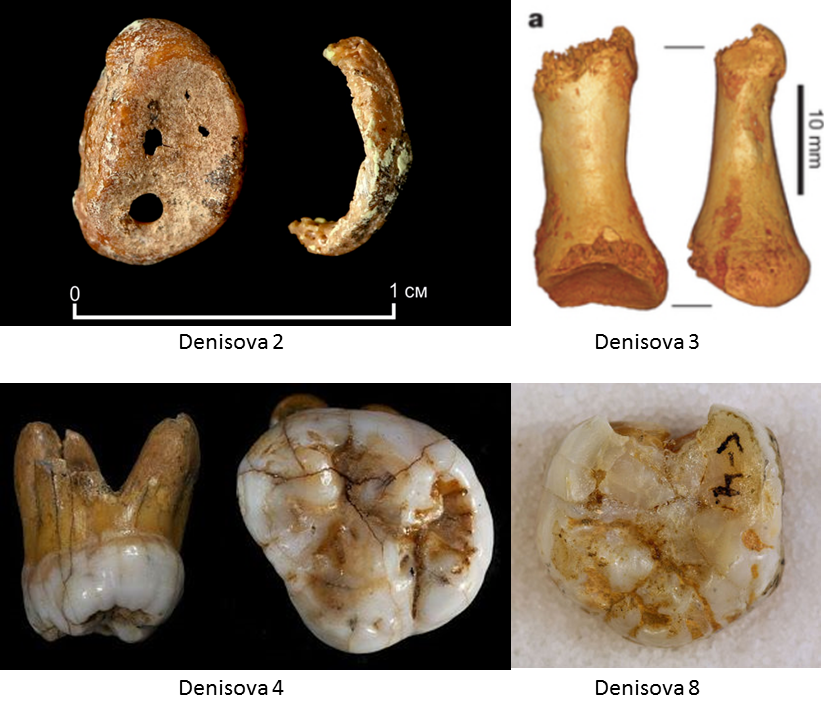
La importancia de este sitio comienza en 2010, cuando se publican una falange de dedo (Denisova 3) y un molar (Denisova 4) encontrados en la cueva. De estos restos se pudo recuperar material genético y fue analizado por el Max Planck Institute. El resultado fue que estos dos especímenes pertenecen a una especie humana distinta, “prima” de los neandertales, que se conoce como “denisovanos” en espera de una definición científica. En 2019 se presentó un fragmento adicional de la falange Denisova 3, descartado hasta ahora.

Se estima que Denisova 3 era una hembra joven y Denisova 4 un macho adulto. En 2010 se halló otro molar, inicialmente considerado de un oso de las cavernas debido a su tamaño y la robustez y morfología de las raíces… Sin embargo esta idea se reconsideró posteriormente y se planteó como un diente humano, lo cual fue confirmado a través del estudio de su ADN: este fósil resultó ser el tercer denisovano conocido (Denisova 8). En 2017, un segundo molar inferior deciduo perteneciente a una hembra infantil denisovana fue publicado (Denisova 2).

En 2019 se presentó un quinto resto denisovano, un fragmento de hueso parietal (Denisova 13), en la reunión anual de American Association of Physical Anthropologists, que en principio tiene una morfología intermedia entre Homo neanderthalensis y H. heidelbergensis y H. erectus. Está pendiente de publicación.
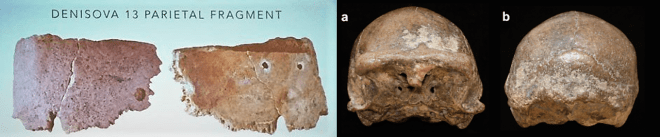
Denisova 13 vs Ngawi

Denisova 13 (izda, foto de @VioLab_UofT) vs Ngawi (dcha, foto de Kaifu, Y. et al 2015), considerado Homo erectus, y con el que Denisova 13 puede tener similitudes morfológicas.

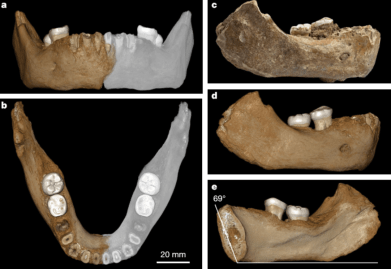
También en 2019 se publicó el primer espécimen denisovano fuera de la cueva Denisova: una mandíbula procedente de la cueva de Karst Baishiya en Xiahe (China), datada en 160 ka, una antigüedad comparable a Denisova-2 [+info].
Xiahe mandible

The Xiahe mandible (a, b, d, e, views after digital removal of the adhering carbonate matrix). Credit: Chen F. et al (2019). A late Middle Pleistocene Denisovan mandible from the Tibetan Plateau doi.org/10.1038/s41586-019-1139-x

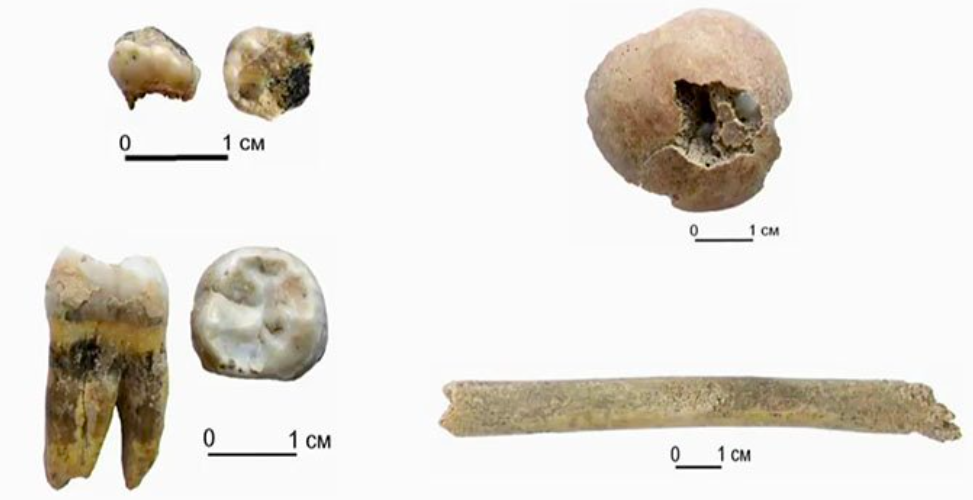
Finalmente (por ahora), en 2020 se ha anunciado en prensa la recuperación en la campaña de verano de cuatro restos humanos: un diente infantil de la parte inferior del nivel 22, que correspondería a una cronología de 250 ka y sería el denisovano más antiguo, un molar adulto de la parte superior del nivel 22 (170-190 ka), y dos fragmentos de hueso de los niveles 13-14, con antigüedad 120~130 ka, tal vez neandertales.
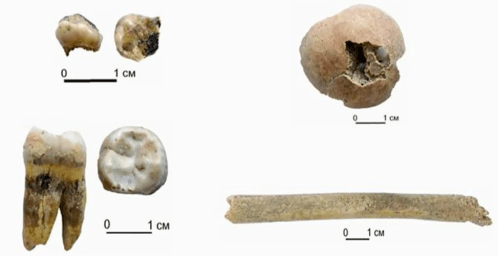
Milk tooth (layer 22 bottom), adult molar (layer 22 top), two bone fragments (layers 13, 14). Source: siberiantimes.com/other/others/news/sensational-find-of-a-250000-year-old-milk-tooth-found-inside-the-denisova-cave-in-siberia/
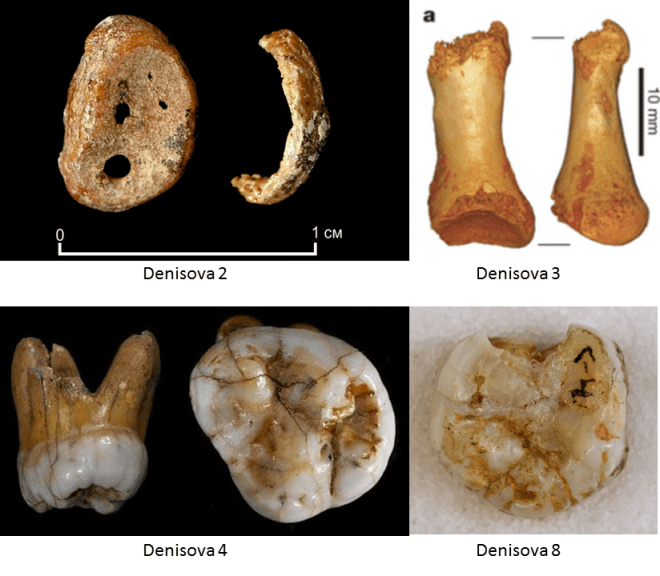
Conozcamos a los denisovanos, que nos están permitiendo definir una especie humana diferente, por ahora tan solo por su material genético:
4 denisovanos

Los cuatro primeros denisovanos hallados. Crédito foto: Max Planck Institute

Sigue leyendo →

A new Denisovan!

The Denisova Cave in Siberia’s Altai Mountains is known for being a unique place, where three different groups of humans lived in the last 100 K years: Denisovans, Neandertals and Modern Humans.

A finger phalanx (Denisova 3) and a molar (Denisova 4) from that site were published in 2010. Fortunately the genetic materials were preserved, allowing the Max Planck Institute to analyse the DNA. They resulted to be a new species, cousin of the Neandertals, named the ‘Denisovans’. Both species share a common ancestor, which in turn shares a common ancestor with Homo sapiens. Moreover, 0.5% of the genome of Denisova 3 was derived from a Neandertal population, probably related to the Neandertals that lived in the Denisova Cave.

Denisovans also interbred with some populations of Homo sapiens, contributing about 5% of the genome of some today’s Oceania people and 0.2% of the genome of Native Americans and main-land Asians.

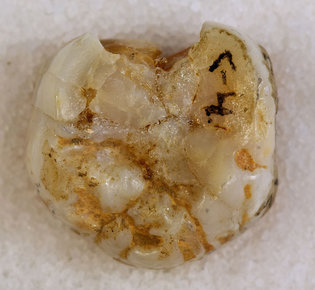
Denisova 3 was a young girl and Denisova 4 was an adult male. A second molar was found in 2010 – thought to belong to a cave bear given its size and huge, splayed roots. This was later reconsidered to be a human tooth. Its DNA was analysed by the Max Planck Institute and published in 2015. It turned out to be another adult male Denisovan specimen (Denisovan 8), the third Denisovan.

What do we know about the Denisovan DNA?

Denisova 8 molar. Photo: Bence Viola

  • Nuclear DNA sequences from the two molars form a clade with the one of the finger phalanx. The three specimens were a single biological group.
  • The mitocondrial DNA of Denisova 8 has accumulated fewer substitutions than the other two specimens. This means that he was present in the region aprox. 60 K years before the other two (c. 110 KYA). The Denisovans either occupied the region at least 110 to 50 KYA, or came into the region at least twice.
  • The nuclear DNA sequence diversity among the three Denisovans is comparable to that among the Neandertals, but lower than that among today’s humans.
  • The new genetic analysis shows less relationship to Neandertals than the analysis from 2010.
  • Although the morphology of third molars is generally variable, both molars Denisova 4 and Denisova 8 are very large and lack traits typical of Neandertals and modern humans.
  • The length of Denisova 8 is comparable to Pliocene hominins. Only two other Late Pleistocene third molars are comparable in size. The size of the two molars may suggest that large teeth is a Denisovan feature.
  • The Denisovan molars also have massively flaring roots and relatively large and complex crowns. They show similarities with the Xujiayao teeth recently described by Xing S., Martinón-Torres M. et al. Large teeth and massive roots are indicative of massive jaws. Could this be the first clue of the Denisovan morphology?

Denisova 4 molar. Photo: Bence Viola

  • As resulted from the 2010 DNA analysis, the Denisova 3 phalanx carries a component derived from an unknown hominin who diverged 1–4 MYA from the lineage leading to Neandertals, Denisovans and today’s humans. That hominin could be Homo erectus, or another ancestor we have not found any fossil yet. This new study has no clear output concerning this component, which seems to differ among the three Denisovan individuals.

Denisova 8, Denisova 4, Neandertal Krapina D109, Homo sapiens. Photo: S. Sawyer et al, PNAS

What’s next?

In March 2018 a new technique was applied to 5,639 whole-genome sequences from Eurasia and Oceania. This study concludes:

  • There was Denisovan introgression in the specimens from East and South Asia and Papuans.
  • At least two distinct instances of Denisovan admixture into modern humans occurred.
  • There is a much closer Denisovan match among Han Chinese, Chinese Dai, and Japanese DNA sequences.